

Try this on for size: you can invoke the First Amendment in any state, demand due process in any state, and refuse an unreasonable search in any state. But if you want to carry a concealed handgun for self-defense and you cross an invisible line on the highway, your legal status can go from “lawful” to “unlawful” fast in states that do not recognize your permit.
That is the pressure point behind a petition asking the Supreme Court to decide whether states must recognize concealed-carry permits issued elsewhere. Two truck drivers, David A. McCoy II and Jeffrey A. Johnson Sr., argue that Minnesota’s refusal to honor their out-of-state permits turns the Second Amendment into what their petition calls a “second-class right.” Minnesota Department of Public Safety Commissioner Bob Jacobson is the named defendant.
Liberty Justice Center first filed the lawsuit in January 2025. The petition asking the Supreme Court to take up the case was filed Aug. 24.
The constitutional question sounds simple. The answer is not. It sits at the intersection of the Second Amendment and federalism: fifty states, fifty sets of rules, and one national Constitution trying to keep the peace.
Join the Discussion
The case for recognition
If you want to argue for mandatory recognition, you start with a practical observation that doubles as a constitutional jab: a right that evaporates when you travel is not much of a right. The petition takes direct aim at the idea that “an individual’s Second Amendment rights are confined to the borders of the state of where he holds a firearm permit.”
Johnson, for example, is a trucker with valid carry permits from Florida and Georgia, but he cannot carry in Minnesota because the state will not recognize them.
Translated into plain English: if one state can require you to “prove yourself” again and again before you can carry for self-defense, then the right to “bear Arms” becomes a patchwork privilege administered by local officials.
The Second Amendment theory
The core claim would read like this, in the petition’s spirit:
- The right is not supposed to stop at a border. The petition argues the right to bear arms in public for self-defense should not be confined to the state that issued the permit.
- Repeated relicensing is the burden. “No matter how many times an ordinary law-abiding citizen proves his worth through a state’s firearm licensing process, another state can force him to do it again” before he can exercise his “constitutional right to bear arms in public for self-defense.”
- Nonrecognition creates a practical trap for travelers. People whose work is interstate by nature can become compliant one moment and out of compliance the next, depending on where the road takes them.
This is the emotional heart of the argument. It is also the rhetorical trap: once you say “a right is a right everywhere,” you have to explain why states are allowed to differ at all.
The federalism problem

Federalism is not a mood. It is a governing system. States have long regulated who may carry concealed weapons, what training is required, what disqualifies an applicant, and what places are off-limits. Those differences are not accidental. They reflect different political cultures and different judgments about risk.
So the federalism objection to national recognition writes itself:
- Licensing is a state police power. States traditionally control public safety rules within their borders, especially regarding weapons in public spaces.
- A permit is a state-created credential. A concealed-carry license is not the Second Amendment itself. It is a regulatory instrument a state uses to decide who may carry concealed, and under what conditions.
- Reciprocity can force a lowest-common-denominator effect. If State A has minimal requirements and State B has stricter ones, mandatory recognition means State B’s standards are effectively overridden for some nonresidents.
Here is the uncomfortable civics-class question: if the Court can force State B to accept State A’s permit, what else can it force State B to accept as a matter of constitutional “recognition”?
Full Faith and Credit
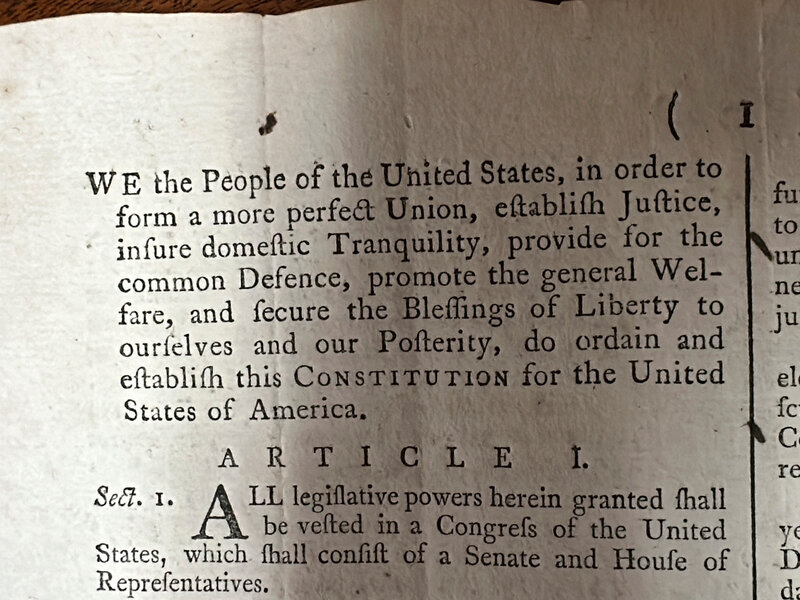
In debates about reciprocity, people often reach for Article IV, Section 1, the Full Faith and Credit Clause: “Full Faith and Credit shall be given in each State to the public Acts, Records, and judicial Proceedings of every other State. And the Congress may by general Laws prescribe the Manner in which such Acts, Records and Proceedings shall be proved, and the Effect thereof.”
It is a fair instinct. It is also not a magic wand. As a matter of constitutional structure, the clause is at its strongest with judgments (court decisions), not necessarily with every licensing choice a state makes. Even so, it matters here because it gives constitutional vocabulary to a basic point: the states are not foreign countries to each other.
It also highlights a separate possibility: Congress has explicit power to prescribe the “effect” of state records and acts, raising a practical question about whether this issue is ultimately more suited to legislation than litigation.
What the Court must decide
One key detail is procedural and it matters: the petition explicitly challenges “the Eighth Circuit’s view” that Second Amendment rights are “confined to the borders of the state of where he holds a firearm permit.”
Even if you agree with the petition’s core complaint, the Court would still have to pick a legal path. Different paths produce different futures. What follows is analysis, not a claim about what the Court will do.
Option 1: A right to reciprocity
The Court could say: once a person is licensed by one state, other states must recognize that license because otherwise the right to bear arms becomes geographically fragile. This would be the boldest move. It would also invite immediate follow-up litigation over limits: training, age thresholds, disqualifying misdemeanors, mental health commitments, and the definition of “sensitive places.”
Option 2: A narrow nonresident rule
The Court could avoid declaring a general reciprocity rule and instead police the most extreme versions of nonrecognition. For example, it might hold that a state cannot entirely deny nonresidents any practical path to lawful public carry, especially for people whose work requires constant interstate travel.
Option 3: Deference to state permits
The Court could also conclude that the Constitution protects bearing arms, but does not require cross-border acceptance of another state’s concealed-carry credential. Under that view, states can be required to respect the underlying right, yet still allowed to demand compliance with their own licensing regime.
Each option tries to answer the same hard question: is the problem the lack of reciprocity, or the scope of state discretion over public carry in the first place?
The license analogy
You will hear the comparison a thousand times: “A carry permit should work like a driver’s license.” I understand the instinct. It feels like common sense.
But legally, it is not a clean match. Driving is generally treated as a heavily regulated activity with broad state control. Carrying for self-defense is tied to an enumerated constitutional right. That difference cuts in both directions:
- Pro-recognition: because it is a right, states should not be able to treat travelers as if they stepped into a foreign legal universe.
- Anti-recognition: because it is a right, states may argue they can regulate the manner of public carry within their territory, including by setting their own licensing terms.
The analogy is useful politically. Legally, it is a fight starter, not a fight finisher.
The question out loud
Here is the question that should be asked, and answered, without slogans: Are we dealing with a national right that states must accommodate as fellow members of one union, or are we dealing with fifty separate public-safety regimes that just happen to sit under a shared Constitution?
If the Court requires cross-border recognition of concealed-carry permits, it will be choosing national uniformity over state variation in one of the most emotionally charged regulatory areas in American life.
If the Court refuses, it will be telling Americans that the practical reach of the Second Amendment is, in significant ways, state-defined and travelers must know the rules where they are.
Either way, the ruling will not just shape gun policy. It will shape the meaning of citizenship in a federal system. And that is what this fight often really is: a fight over who gets to define “the People” when the interstate sign says Welcome, but the criminal code says Not so fast.
FAQ
Is the Supreme Court required to take the case?
No. The Court chooses most of its docket. It may wait for clearer conflicts among federal appeals courts or for the issue to mature across multiple cases.
Could Congress impose national reciprocity instead?
Congress can try, and it would likely lean on its Article IV power to prescribe the “effect” of state records as well as other constitutional authorities. Any such law would almost certainly be challenged, meaning the Supreme Court could be drawn in either way.
Does “recognition” mean you can carry everywhere inside a state?
Not necessarily. Even strong reciprocity proposals usually preserve local restrictions like bans in certain government buildings or other designated sensitive places. The real clash is about whether you can carry at all under your existing permit, not whether every location becomes lawful.