
The smoke from “Operation Epic Fury” had barely begun to clear over Tehran when a secondary, equally volatile conflict ignited within the halls of the U.S. Capitol. Following a massive joint U.S.-Israeli military campaign that reportedly resulted in the death of Supreme Leader Ali Khamenei, President Trump finds himself at the center of a constitutional firestorm over the limits of executive war-making power.
While the administration celebrates a tactical victory, constitutional scholars and a bipartisan coalition of lawmakers are questioning the legality of a massive offensive launched without a formal declaration of war or specific congressional authorization.
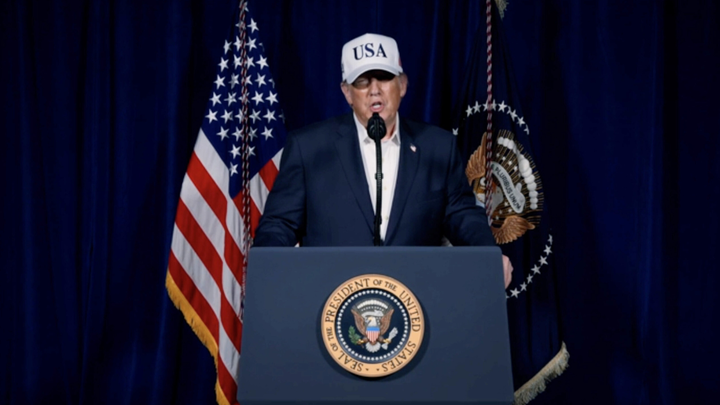
The Executive Argument: “Imminent Threat” and Article II
The Trump administration’s legal justification for the strikes rests firmly on the President’s inherent powers as Commander-in-Chief under Article II of the Constitution. Legal experts and administration officials argue that the President possesses the unilateral authority to order military action to protect American lives and interests from an “imminent threat”.
- Preemptive Defense: The administration contends that the strikes were a necessary preemptive measure to disrupt planned Iranian attacks on U.S. regional assets and prevent a nuclear breakout.
- Decapitation Strategy: Officials argue that targeting high-ranking leaders like Khamenei falls under the President’s duty to neutralize specific threats to national security.
- The “Special Relationship”: The administration maintains that the joint nature of the operation with Israel underscores the President’s authority to conduct foreign policy and defense alliances without immediate legislative oversight.
The Congressional Pushback: The War Powers Resolution
On Capitol Hill, the reaction has been a mixture of shock and constitutional alarm. Key lawmakers from both parties have criticized the administration for failing to provide prior notification or seek authorization before launching a campaign of such magnitude.
- Violation of the 1973 Act: Critics argue that “Operation Epic Fury” violates the War Powers Resolution of 1973, which requires the President to consult with Congress “in every possible instance” before introducing U.S. Armed Forces into hostilities.
- Demand for Briefings: Top Democrats and several prominent Republicans have demanded immediate, classified briefings on the intelligence used to justify the “imminence” of the threat.
- The 48-Hour Clock: Under the War Powers Act, the President must formally report the commencement of hostilities to Congress within 48 hours, a deadline that many lawmakers are watching with intense scrutiny.
“The President does not have a blank check to start a regional war without the consent of the people’s representatives,” stated a leading member of the Senate Foreign Relations Committee.
The Framers’ Fear of the “Executive Sword”

The Framers were deeply wary of granting a single individual the power to initiate war. In Federalist No. 69, Alexander Hamilton explicitly distinguished the American President from the British King, noting that the President’s power “would amount to nothing more than the supreme command and direction of the military and naval forces,” while the power to declare war was reserved solely for Congress.
By bypassing Congress to “obliterate” the leadership of a sovereign nation, the administration is effectively asserting that the “Executive Sword” can be drawn whenever the President deems it necessary for “peace”.
This creates a precedent where the definition of “hostilities” can be narrowed to exclude massive bombing campaigns, provided they are framed as “pinpoint” or “surgical”.
The Regional Fallout: A Middle East in Flux
While the legal battle rages in D.C., the physical battle continues across the Middle East. The strikes have triggered a wave of retaliation that has placed U.S. forces and allies in immediate peril.
- Retaliatory Salvos: Iranian-backed militias have launched drones and missiles at U.S. installations in Iraq and Syria.
- Economic Shock: Global markets are reacting to the potential closure of the Strait of Hormuz, with oil prices spiking in anticipation of a prolonged conflict.
- Humanitarian Concerns: Reports of civilian casualties from the “pinpoint” strikes are fueling international condemnation and complicating the administration’s diplomatic efforts.
Conclusion: A Constitutional Crossroads
The strikes on Iran have forced a long-overdue reckoning with the War Powers Act. As the President continues his “uninterrupted” campaign, the question is no longer whether the President can bypass Congress for now—he already has. The question is whether Congress has the political will to reassert its Article I authority before the 48-hour clock expires and a temporary strike becomes a permanent regional war.

The 2026 constitutional landscape is one where the “Power of the Purse” and the “Power of the Gavel” are being tested by a President who relies almost exclusively on the “Power of the Sword.” As “Operation Epic Fury” moves into its second day, the ultimate outcome may be decided not on the battlefields of Iran, but in the hearing rooms of the U.S. Capitol.