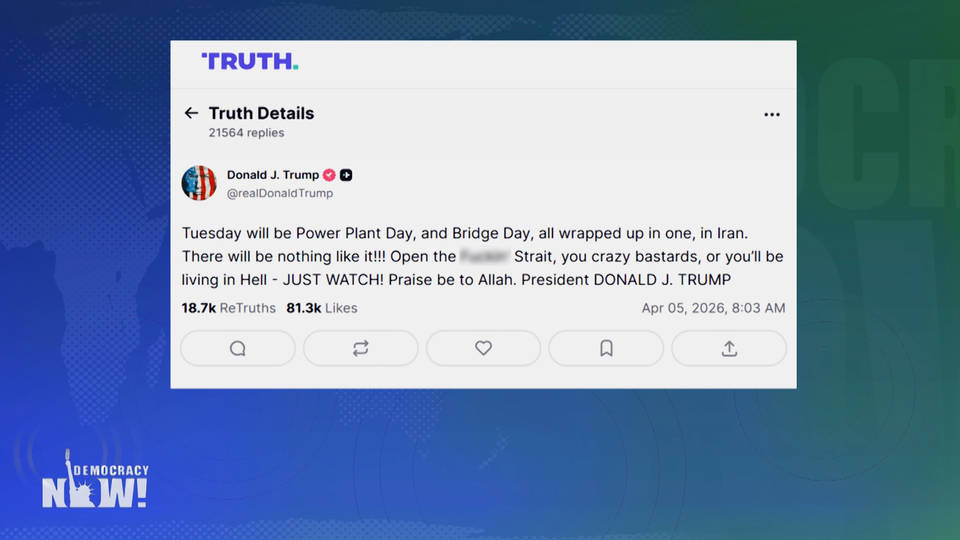
On Easter morning, President Donald Trump posted a message about Iran that was equal parts threat and spectacle. It included profanity, a deadline tied to the Strait of Hormuz, and even a religious sign-off: “Praise be to Allah.” But this was not posted into a vacuum. It landed as the war between the U.S. and Iran entered its 37th day, with fighting continuing despite Trump’s earlier claim that Iran had been “completely decimated.” Reports also indicated Iranian officials warned that further attacks could have catastrophic regional consequences, raising fears of a broader Middle East crisis.
The reaction was immediate. Sen. Chris Murphy called the post “completely, utterly unhinged.” Others went further, urging the Vice President and the Cabinet to consider the 25th Amendment.
Join the Discussion
Trump’s Easter message
Trump renewed his threats against Iran in a profanity-laced post on Truth Social, warning Iran would face severe consequences if the Strait of Hormuz, a critical route for oil shipments, was not reopened by Tuesday.
“Tuesday will be Power Plant Day, and Bridge Day, all wrapped up in one, in Iran,” Trump wrote on Sunday. “There will be nothing like it!!! Open the [F***in'] Strait, you crazy bastards, or you'll be living in Hell – JUST WATCH! Praise be to Allah. President DONALD J. TRUMP.”
What “invoke the 25th” means
Whenever the 25th Amendment gets tossed into the conversation, Americans tend to hear a simple promise: remove the president. But the Constitution is rarely that tidy. The hard question is not whether people are angry. It is whether our system has a clear, legitimate way to declare a president unable, and what that would mean for the millions of voters who put him there.
The 25th Amendment was not written for “bad judgment” or “offensive speech” or “reckless posting.” It was written to answer a more terrifying problem: what happens when a president is alive, still technically in office, but cannot do the job?
That problem became urgent after President John F. Kennedy was assassinated in 1963. The amendment was added to clarify the rules for replacing a deceased or incapacitated president, and it was ultimately ratified in 1967.
So when critics point to Trump’s Easter post and say the Cabinet should act, they are not making a criminal accusation. They are making an incapacity accusation. That difference matters because it changes the process, the standard, and the players.
Backlash and calls to act
Trump’s harsh tone was met with criticism by lawmakers and others around the country, with many calling for his removal from the White House by way of the 25th Amendment.
Rep. Yassamin Ansari (D, Ariz.) said she believes he’s a national security threat. Rep. Melanie Stansbury (D, N.M.) urged Congress and the Cabinet to act.
Sen. Chris Murphy (D, Conn.) wrote, “If I were in Trump’s Cabinet, I would spend Easter calling constitutional lawyers about the 25th Amendment. This is completely, utterly unhinged. He’s already killed thousands. He’s going to kill thousands more.”
Anthony Scaramucci, financier and former White House Communications Director briefly to Trump during his first presidency, argued the country should remove Trump, writing: “It was at this point that our Founders thought the best thing to do would be to remove a mad man who has the executive office. It became more formalized with the 25th amendment, but more people now should be calling for this man’s removal.”
Former GOP Congressman Joe Walsh said Trump “will forever be a stain on this country.”
The Council on American-Islamic Relations responded by assailing Trump’s “deranged mocking of Islam.”
Two sections people mix up
Section 3: voluntary transfer
This is the clean, voluntary route. To temporarily transfer power to the vice president, a president sends a letter to the Speaker of the House of Representatives and the President pro tempore of the Senate saying he is “unable to discharge the powers and duties of his office.” The vice president becomes acting president.
When the president is ready to resume, he sends another letter and takes the powers back. That process is spelled out in Section 3.
Section 4: VP and Cabinet act
This is what people usually mean when they talk about “removing” a president via the 25th. Section 4 lays out what happens if the president becomes unable to carry out his duties but does not transfer power.
In that case, the vice president and a majority of the Cabinet can declare the president unfit. They would send a letter to the Speaker and the President pro tempore saying so, and the vice president then becomes acting president.
Who can actually do it
This is where the civics gets uncomfortable. Your vote is not the mechanism here. Neither is a court. And despite all the public noise, Congress does not start the process.
- The trigger belongs to the vice president and the Cabinet, not to voters and not to lawmakers posting their outrage.
- Congress enters the picture through the letter process, because the declarations are sent to the Speaker of the House and the President pro tempore of the Senate.
That design is why the online chant to “invoke the 25th” can feel both potent and empty at the same time. The people who have to move first are the people closest to the president.
What it means for your vote
Let’s say Section 4 were invoked. Would that “undo” an election? Not exactly. But it would do something voters rarely contemplate: it would transfer the authority of the presidency to someone else without a new national vote.
That is not a bug. It is the point. The Constitution assumes a country may face emergencies where waiting for the next election is impossible or dangerous. So it creates a continuity mechanism that is not democratic in the direct sense, but is still legitimate under the rules we have chosen.
Here is the real trade: when you elect a president, you are also implicitly accepting the constitutional contingency plans attached to that office. That includes succession. And yes, it includes the 25th Amendment.
Why this keeps coming up
Calls to use the 25th Amendment against President Trump are not new. Similar demands surfaced after the Capitol riot on Jan. 6, 2021. More recently, the idea reappeared over his push to take control of Greenland.
That repetition tells you something important about our political culture: Americans increasingly treat the presidency like a stress point in the whole system. When the president looks volatile, people do not first reach for Congress. They reach for emergency constitutional tools.
That should worry you, regardless of which party you belong to.
“Unable” according to whom?
The 25th Amendment does not give us a neat medical checklist. It does not define “unfit” or “unable.” It does not require a psychiatric diagnosis. It does not mandate a panel of doctors. It relies on human judgment, and it places that judgment in the hands of people who have personal loyalty and political incentives.
So ask yourself the question that matters more than any single post.
- If a Cabinet can declare a president unable because his conduct is dangerous, what stops a future Cabinet from using the same channel to settle a political fight?
- If Section 4 is too hard to use even in a genuine crisis, does it function as a safeguard at all?
The 25th Amendment was meant to stabilize the republic. But it also puts a loaded constitutional tool on the table. Once a political culture starts reaching for it casually, the presidency becomes less an elected office and more a conditional lease held at the pleasure of insiders.
So what happens now?
Trump’s Easter message about Iran and the Strait of Hormuz may be remembered as a political embarrassment, a national security alarm bell, or just another outrageous moment in the modern presidency. But the constitutional lesson is bigger than the news cycle.
If the 25th Amendment is invoked under Section 4, it will not be because “the public demanded it.” It will be because the vice president and a majority of the Cabinet decide to place the country into a constitutional procedure that temporarily sidelines the person voters chose.
That may be necessary in a true incapacity crisis. It may also be abused in a legitimacy crisis. The Constitution allows it, but the Constitution cannot guarantee wisdom.