
In the Senate, most big fights eventually run into the same math problem: 60 votes. That is the practical threshold for ending debate on most contested legislation because of the filibuster and the cloture vote used to end debate.
Budget reconciliation is the workaround Congress created for certain budgetary laws. It is not a loophole in the Constitution. It is a procedure built into federal budget law and Senate rules that lets qualifying tax, spending, and debt-limit legislation move through the Senate with a simple majority, meaning a majority of those voting (assuming a quorum).
That difference has turned reconciliation into one of the most consequential tools in modern lawmaking, especially in an era where 60 votes is often unattainable.
Join the Discussion
What budget reconciliation is
Reconciliation is a special legislative process designed to align existing law with Congress’s budget plan. The basic idea is simple: if Congress adopts a budget blueprint that assumes certain spending cuts, revenue increases, or deficit changes, reconciliation is the fast-track mechanism to make the statutory changes needed to achieve those numbers.
The process comes from the Congressional Budget Act of 1974. It was created to help reconcile tax and spending laws with the budget resolution and coordinate decisions across committees. Over time, it evolved into something else: the most reliable way for a narrow Senate majority to pass major fiscal policy without needing to overcome a filibuster.
Why reconciliation can pass with 51 votes
The critical point is not that reconciliation abolishes the filibuster. It is that reconciliation bills are considered under special Senate procedures that limit debate.
- Debate time is capped. In the Senate, debate on a reconciliation bill is generally limited to 20 hours.
- No filibuster-style open-ended debate. A filibuster works by extending debate indefinitely. With a hard cap on debate, the Senate can proceed toward final passage.
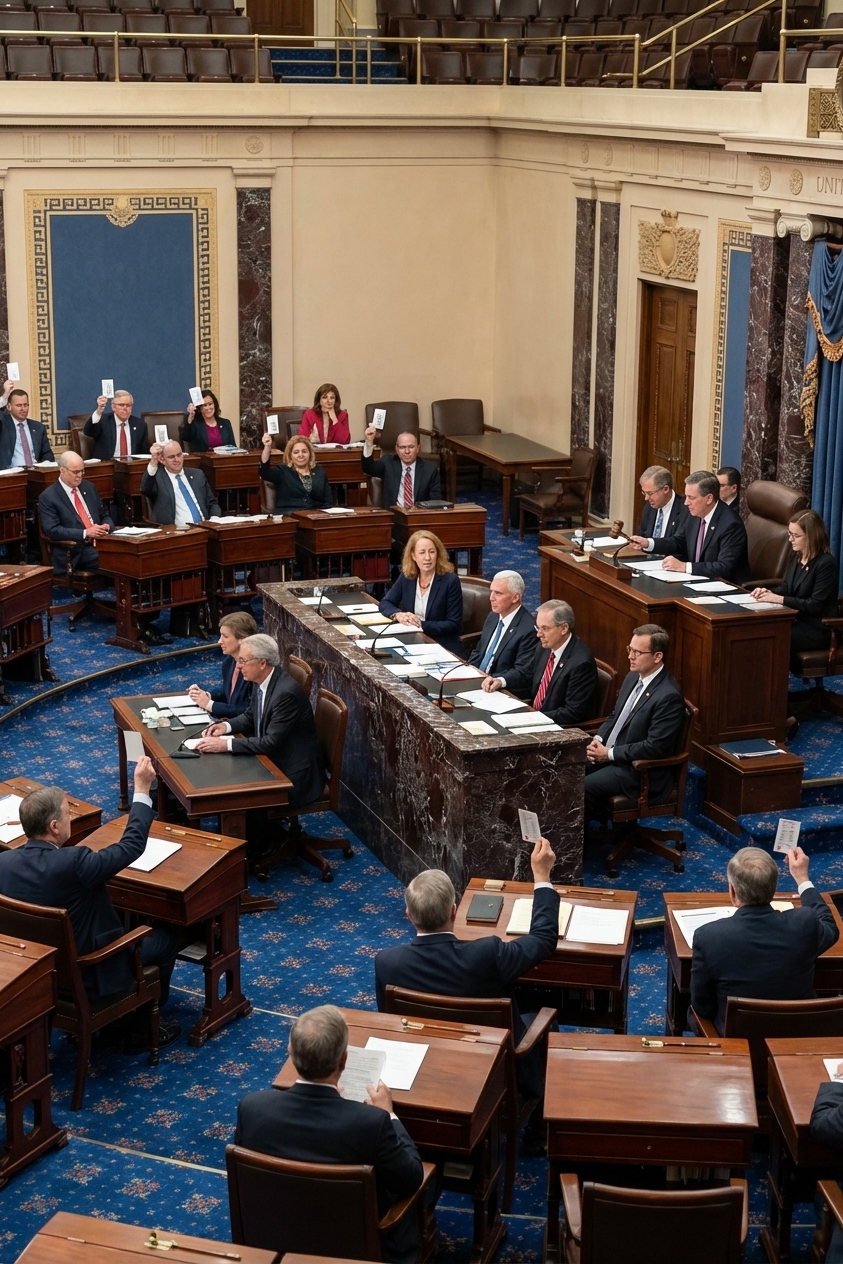
- Final passage is by simple majority. After debate time is used, the Senate votes, and the bill passes with a majority of those voting. In a 50-50 Senate, the Vice President can cast a tie-breaking vote.
One practical wrinkle: the 20-hour debate cap does not necessarily mean the process ends quickly. After debate time expires, the Senate can continue voting on amendments in a rapid-fire stretch known as a “vote-a-rama,” which can run long.
That is why reconciliation is so politically powerful: it converts a Senate where 60 votes is often the functional requirement into a Senate where a majority can be enough for certain fiscal bills.
How reconciliation happens
Reconciliation is not a free-floating option leadership can invoke at will. It normally follows a sequence:
1) Congress adopts a budget resolution
A budget resolution is a concurrent resolution that sets spending and revenue targets. It is not signed by the President and does not become law. Think of it as Congress agreeing on a fiscal blueprint.
2) The budget resolution includes instructions
If Congress wants to use reconciliation, the budget resolution can direct specific committees to produce legislation that changes spending, revenues, or the debt limit by certain amounts.
For completeness: in theory, a budget resolution can trigger up to three reconciliation bills, one each for spending, revenues, and the debt limit. In practice, Congress often combines them, and the real-world number has varied over time based on Senate practice and political strategy.
3) Committees draft the text
The instructed committees write the policy changes that hit the fiscal targets. Those pieces are assembled into an omnibus reconciliation bill.
4) The House and Senate consider it under special rules
The Senate’s debate limit is the headline feature. In practice, reconciliation also triggers the Byrd Rule, which can strip provisions that do not meet reconciliation’s budget-centered purpose.

Reconciliation vs regular bills
Most bills in Congress travel the long road: hearings, markups, floor debate, amendments, conference negotiations, and in the Senate, the ever-present 60-vote threshold when a filibuster is threatened.
Reconciliation is different in ways that matter:
- Filibuster-resistant procedure. Regular Senate bills can be stalled unless 60 senators vote to end debate. Reconciliation bills are considered under rules that limit debate, so they cannot be filibustered in the usual way.
- Narrow subject matter. Regular legislation can cover almost anything within Congress’s constitutional powers. Reconciliation must implement budget instructions and survive the Byrd Rule.
- Amendment dynamics. Reconciliation often produces a rapid-fire amendment process at the end of debate known as a “vote-a-rama,” where senators vote on many amendments in quick succession.
- Limits on what you can add. Reconciliation is not supposed to be a general policy vehicle, even if modern Congress frequently tries to use it that way.
In plain terms: reconciliation is easier to pass, but harder to use for non-budget policy.
The Byrd Rule
The Byrd Rule is named for Senator Robert Byrd, who pushed to prevent reconciliation from turning into a filibuster-proof substitute for normal lawmaking.
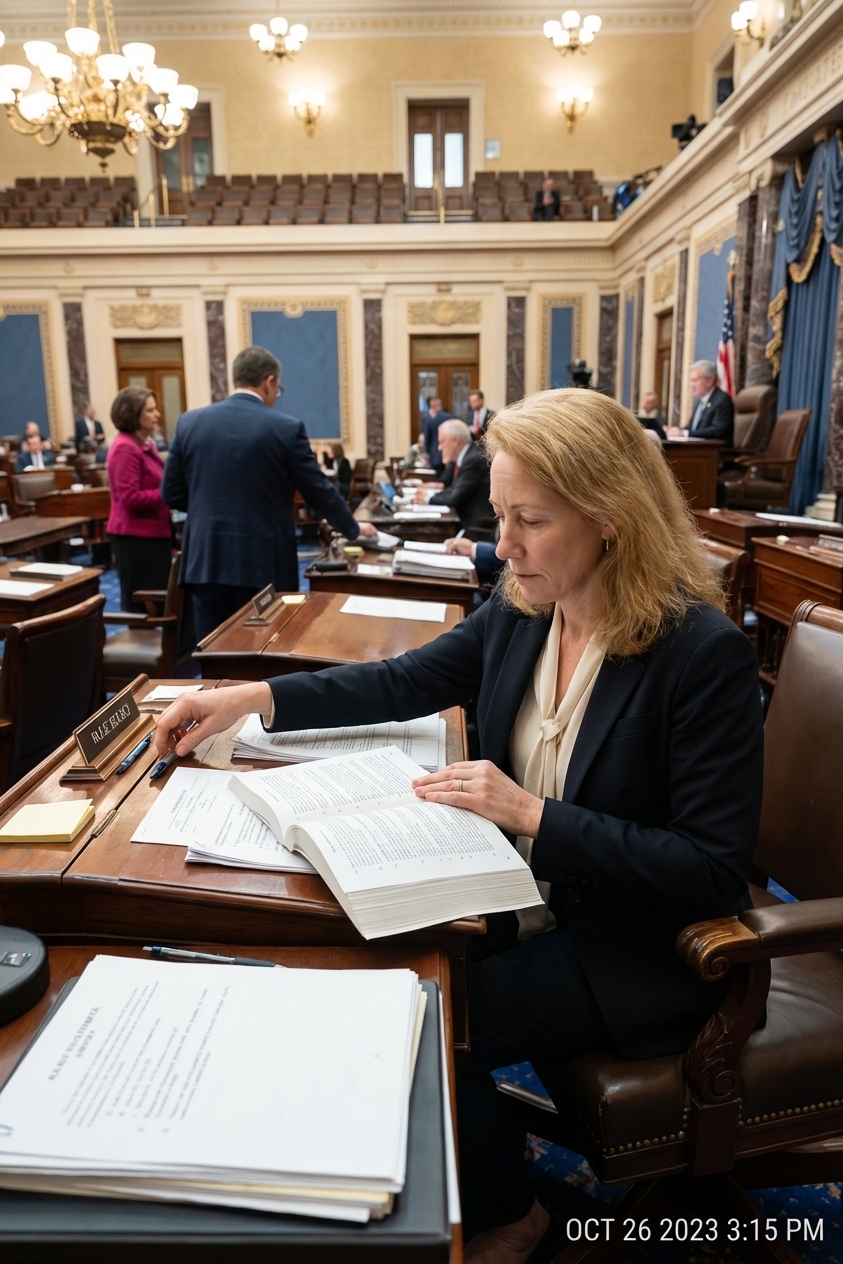
It works like this: a senator can raise a point of order against provisions considered “extraneous” to the budget. If the point of order is sustained, the provision is removed unless the Senate votes to waive the rule. Waiving typically requires 60 votes, which defeats the purpose of reconciliation.
So what counts as “extraneous”? While the analysis can get technical, the core idea is straightforward. A provision is vulnerable if:
- It does not change spending or revenue in more than an incidental way.
- Its budget effects are merely a side effect of a broader policy change.
- It increases the deficit outside the budget window set by the resolution (often 10 years), unless other rules are satisfied.
- It falls outside the jurisdiction of the committee that submitted it.
- It makes changes to Social Security. The Byrd Rule bars Social Security provisions from reconciliation.
The Byrd Rule is enforced through the Senate Parliamentarian’s guidance and the presiding officer’s rulings. As a matter of practice, the presiding officer almost always follows the Parliamentarian’s advice, which is why reconciliation bills are written in a very specific way: policy goals are translated into taxes, credits, penalties, and spending formulas that can be defended as budget changes.
What reconciliation can and cannot do
Because reconciliation is tied to spending and revenue, it tends to favor certain kinds of policy changes and struggle with others.
Good for
- Tax cuts and tax increases
- Changes to mandatory spending programs (Medicare, Medicaid, certain benefits, subsidies)
- Creating or restructuring credits, penalties, and funding streams
- Sometimes, raising or suspending the debt limit if included in instructions
Bad for
- Pure regulatory policy with minimal fiscal effects
- Broad labor and employment mandates that are not primarily budgetary
- Immigration changes that are primarily status and enforcement rules rather than fiscal provisions
- Structural reforms that cannot be credibly scored as budget-driven
Notice what is missing: reconciliation is not built for the kind of sweeping non-fiscal policy that dominates major-party priorities. That mismatch between ambition and procedural limits is what makes the Byrd Rule a recurring headline.
Historical uses
Reconciliation existed for years before it became a political weapon. But as the Senate grew more polarized and the filibuster became routine, reconciliation started doing the heavy lifting for major policy.
Reagan-era budget fights
In the early 1980s, reconciliation was used to implement parts of President Ronald Reagan’s fiscal agenda, including spending reductions and tax-related changes. This is closer to reconciliation’s original spirit: aligning law with a budget plan.
1990s: deficits, welfare, and taxes
Reconciliation bills were used repeatedly during the 1990s for deficit-reduction packages and tax measures. The decade shows the dual nature of reconciliation: it can be austerity, it can be expansion, but it is almost always about budgetary levers.
2001 and 2003: major tax cuts
President George W. Bush’s tax cuts were passed through reconciliation. One practical consequence: because of the budget window and Byrd Rule constraints, parts of those tax cuts were designed to “sunset” after a set number of years. The logic is procedural as much as political: sunsets can keep the official long-term deficit impact inside the window used for scoring.
2010: the ACA fix
The Affordable Care Act’s main bill passed the Senate through regular order, but a significant package of changes to the law moved through reconciliation. This episode cemented a modern pattern: when the Senate cannot clear 60 votes, Congress designs policy in two parts, with the fiscal portion routed through reconciliation.
2017: tax reform and attempted ACA repeal
The Tax Cuts and Jobs Act of 2017 used reconciliation. So did the Senate’s attempt to repeal and replace major parts of the ACA. The latter effort demonstrated reconciliation’s limits as much as its power, because the process cannot solve political disagreement inside a majority.
2021-2022: pandemic and climate policy
Major COVID-era relief and later a large climate and health package, the Inflation Reduction Act, were enacted through reconciliation. These bills showcased how modern majorities use reconciliation to do what would almost certainly fail under a 60-vote Senate.
The through line across these decades is not a single party’s strategy. It is a structural shift: reconciliation became the dependable lane for big-ticket legislation once the 60-vote Senate became the default reality.
Why reconciliation dominates
Reconciliation rose because it solves a specific modern problem: a Senate where most major legislation needs bipartisan support to reach 60 votes, but bipartisan support is increasingly rare.
That makes reconciliation attractive for three reasons:
- It lowers the vote threshold. In practice, it turns the Senate into a majoritarian body for certain fiscal issues.
- It forces policy into budget language. Credits, taxes, subsidies, penalties, and funding formulas are easier to pass than sweeping regulatory frameworks.
- It rewards party unity. If a party controls the House, the Senate, and the presidency, reconciliation offers a path to enact core promises without negotiating with the minority.
The cost is real. When the biggest laws are built to fit Senate procedure rather than legislative clarity, Congress ends up writing policy with one eye on the Parliamentarian and the other on vote counts. The result can be legislation that is complicated by design, temporary by necessity, or split into awkward components because only some parts qualify for reconciliation.
Reconciliation and the Constitution
The Constitution does not mention reconciliation, filibusters, or the Byrd Rule. It sets the broad architecture: Congress makes laws, each chamber sets its own rules, and revenue bills originate in the House.
Reconciliation lives in the space where constitutional structure meets congressional self-governance. The House and Senate are free to design procedures. Over time, those procedures can become as important as the text of a bill because they determine what can realistically pass.
That is why reconciliation keeps showing up in constitutional conversations. Not because it is constitutional law, but because it shapes how a constitutional system actually functions in the real world.

The takeaway
Budget reconciliation is Congress’s fast-track method for passing certain tax, spending, and debt-related laws with a simple Senate majority. It avoids the filibuster by limiting debate, but it pays a price in scope and design because of the Byrd Rule’s restrictions.
If you want to understand why major legislation so often arrives as a sprawling fiscal package, why provisions expire on paper, or why policy is rewritten as a tax credit instead of a direct mandate, reconciliation is usually the missing piece.
It is not just a process. It is the modern Senate’s escape hatch, and increasingly, its main door.