
A warrant is supposed to be the Constitution’s way of forcing the government to slow down, look closely, and justify itself. It is the point where suspicion has to harden into something more than a hunch.
So what happens when a warrant is influenced by a machine’s “maybe,” and that maybe starts to feel like enough to put a person in a cell for months?
That question is no longer hypothetical for Angela Lipps, a 50-year-old Tennessee mother and grandmother who spent more than five months in custody after investigators in and around Fargo, North Dakota used AI facial recognition as part of an effort to connect her to a bank fraud suspect. Lipps says she had never set foot in North Dakota before she was transported there in custody.

Join the Discussion
A face match to handcuffs
Here is the timeline we know from public statements by law enforcement and from Lipps’ legal team.
- July 1: A judge in North Dakota signed a warrant for Lipps’ arrest, with nationwide extradition.
- July 14: Lipps was arrested in Tennessee.
- Over three months: She remained in a Tennessee jail before she was extradited to North Dakota.
- October: Tennessee law enforcement told the Cass County Sheriff’s Office they had Lipps’ extradition waiver.
- December 12: Fargo police said the State’s Attorney’s Office informed a detective that the defense had provided “potential exculpatory evidence.”
- December 23: Prosecutors, the detective, and the judge “mutually agreed to dismiss the charges without prejudice to allow for further investigation.”
- Christmas Eve: Lipps was released.
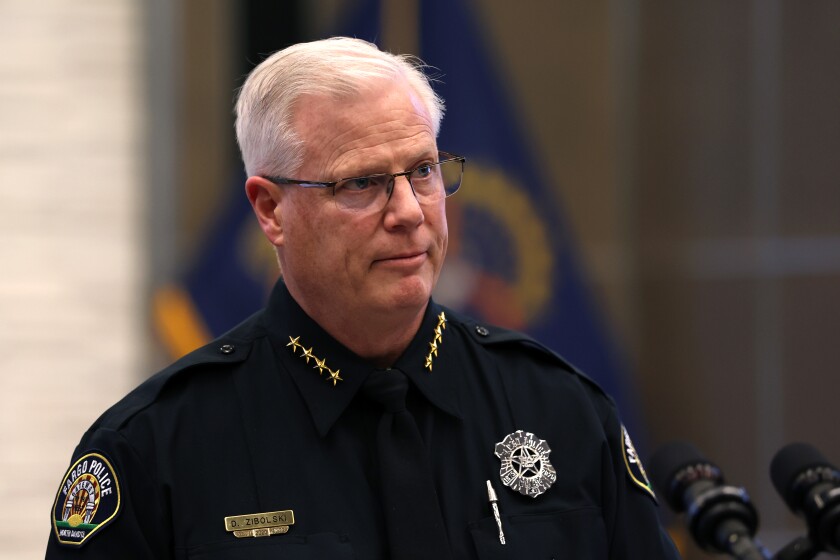
Fargo Police Chief Dave Zibolski has said his department used “our partner agency’s facial recognition technology” and also took “additional investigative steps independent of AI to assist in identification” before submitting the report to the Cass County State Attorney’s Office. At the same time, he acknowledged a basic problem: “part of the issue,” he said, was Fargo’s reliance on information produced by a neighboring agency’s AI system. It is unclear what other evidence was used to tie Lipps to the crimes.
Fargo has also said it does not have its own AI-powered facial recognition tools. West Fargo does. Zibolski said West Fargo purchased its own system without Fargo’s executive-level awareness, and he added that Fargo would not have allowed it to be used and that it has since been prohibited.
West Fargo police have said it uses Clearview AI, a tool built on a database of billions of images scraped from the internet, including social media. West Fargo police said Clearview identified a “potential suspect with similar features to Angela Lipps,” and that report was shared with Fargo investigators. West Fargo also said it did not forward any charges and did not have enough evidence to charge anyone for the fraud case in West Fargo.
Zibolski described a concrete breakdown in how information moved between agencies. He said Fargo investigators “assumed wrongly” that West Fargo had also sent the surveillance photos along with the photo ID, when that was not the case.
Probable cause is not outsourceable
The Fourth Amendment does not forbid arrests. It forbids unreasonable arrests. And it demands that warrants rest on probable cause, supported by oath or affirmation, and that they describe with particularity who and what the government is after.
AI facial recognition throws sand into that machinery because it can tempt investigators to treat a computer-generated match as a substitute for the hard work of establishing identity. A match might be a lead. It is not the same thing as probable cause.
To be clear, the constitutional violation is not “a machine was used.” The constitutional risk is what can happen next: a warrant application that treats algorithmic guesswork as if it were reliable identification. And if warrant applications do not disclose how a match was generated, what the limitations were, and whether the result was merely a candidate among others, then the “neutral and detached magistrate” begins to sound like a slogan instead of a safeguard.
That is why Zibolski’s point about missing surveillance photos matters. Warrants are only as sound as the facts and verification behind them. Assumptions and absent attachments can become the difference between freedom and a jail cell.
Due process starts early
Most Americans think of “due process” as a courtroom drama: a judge, a jury, a verdict. But the Fifth and Fourteenth Amendments are also about the machinery that drags a person into that courtroom in the first place.
Lipps’ case raises an unglamorous but crucial question: how many off-ramps failed before months of pretrial detention became the default setting?
Her lawyers argue the state could have avoided this if investigators had done the ordinary work of checking whether she was even in North Dakota when the crimes occurred. They have said, “Officers knew that Angela was a Tennessee resident, and we have seen no investigation by officers to determine whether she traveled to or was in North Dakota at the time of the bank thefts.” They call the AI match “a shortcut for basic investigation.”
Then there is the time factor. Fargo police have said they could not determine whether Lipps’ extended stay in a Tennessee jail was tied to a probation violation or to contested extradition. Zibolski also said there was not an easy mechanism for North Dakota officials to learn promptly that someone arrested on their warrant was in custody, and the department is considering measures such as daily booking roster review.
That sounds bureaucratic, but it is constitutional in practice. Each additional day the state holds someone who may be innocent is another day liberty is being taken without adequate justification.

Dismissed, not resolved
The charges against Lipps were dismissed “without prejudice,” meaning the state left itself room to refile if it believes later investigation supports it. Fargo police have said the case remains open and that charges could return.
Legally, that is not unusual. Civically, it should still bother us.
If a person can be jailed for months after an investigative chain includes a facial recognition “potential suspect,” then released when alibi evidence surfaces, the obvious next question is: what exactly must be true before the state is willing to say, plainly, “We arrested the wrong person”?
When asked whether he would apologize, Zibolski said, “At this juncture, we still don’t know who’s involved and who’s not involved.” He added, “No one wants to see someone detained, arrested unnecessarily.” Those words acknowledge harm without owning it. That is a familiar move in modern governance, and it is a bad habit for a constitutional republic.
What should change
This is the part where some readers will say: fine, just ban the technology. Others will say: fine, just improve it.
Neither answer is sufficient on its own, because this is not only a technology story. It is a power story.
Ian Adams, an assistant professor in criminology and criminal justice at the University of South Carolina, put it bluntly: “We’re doing it so quickly that all agencies really have to rely on is vendor promises.” He also warned that the worst outcomes are usually a mix of tool misuse and human failure: “The overwhelming amount of the time, it’s not just a technology problem, it’s a technology and people problem.”
So here are the baseline demands a Fourth Amendment culture should insist on, whether an agency uses AI internally or receives AI results from a neighbor:
- Disclosure in warrant applications that facial recognition was used, by whom, under what policy, and with what confidence ranking or candidate list, where available.
- No single-source identity where a face match alone can justify probable cause without independent corroboration tied to time and place.
- Qualified image review of surveillance and ID images by trained personnel, with documentation of limitations like resolution, angle, or lighting.
- Fast-track alibi checks when the suspect lives out of state, including readily available records that can place a person elsewhere.
- Accountability for the chain of information so that assumptions and missing attachments do not become the difference between freedom and a jail cell.
Fargo police have promised operational changes, including no longer sending or using information from West Fargo’s system because Fargo does not know how it is run or overseen, and routing facial recognition identifications through a higher-level review process. Zibolski also said Fargo erred by not submitting surveillance photos to the North Dakota State and Local Intelligence Center, which he described as certified and trained in facial recognition, and that the center has since provided other potential suspects based on the surveillance footage.
Those are steps. They are not a constitutional cure. The cure is cultural: a renewed insistence that the state prove its case before it takes your liberty.
The lingering question
The Bill of Rights was written for a world of quill pens and candlelight. But it anticipated a timeless temptation: the government’s urge to treat efficiency as innocence.
When a computer says “possible match,” it feels like progress. When that match becomes a cross-country extradition and months behind bars, it feels like something older: the state moving faster than its evidence.
If an algorithm can help trigger a warrant, what, exactly, is the citizen’s protection supposed to be? A judge who never sees the uncertainty? A defense attorney who gets the exculpatory records only after the damage is done? Or a public that shrugs because the system eventually corrected itself?
The Constitution is not satisfied by “eventually.”