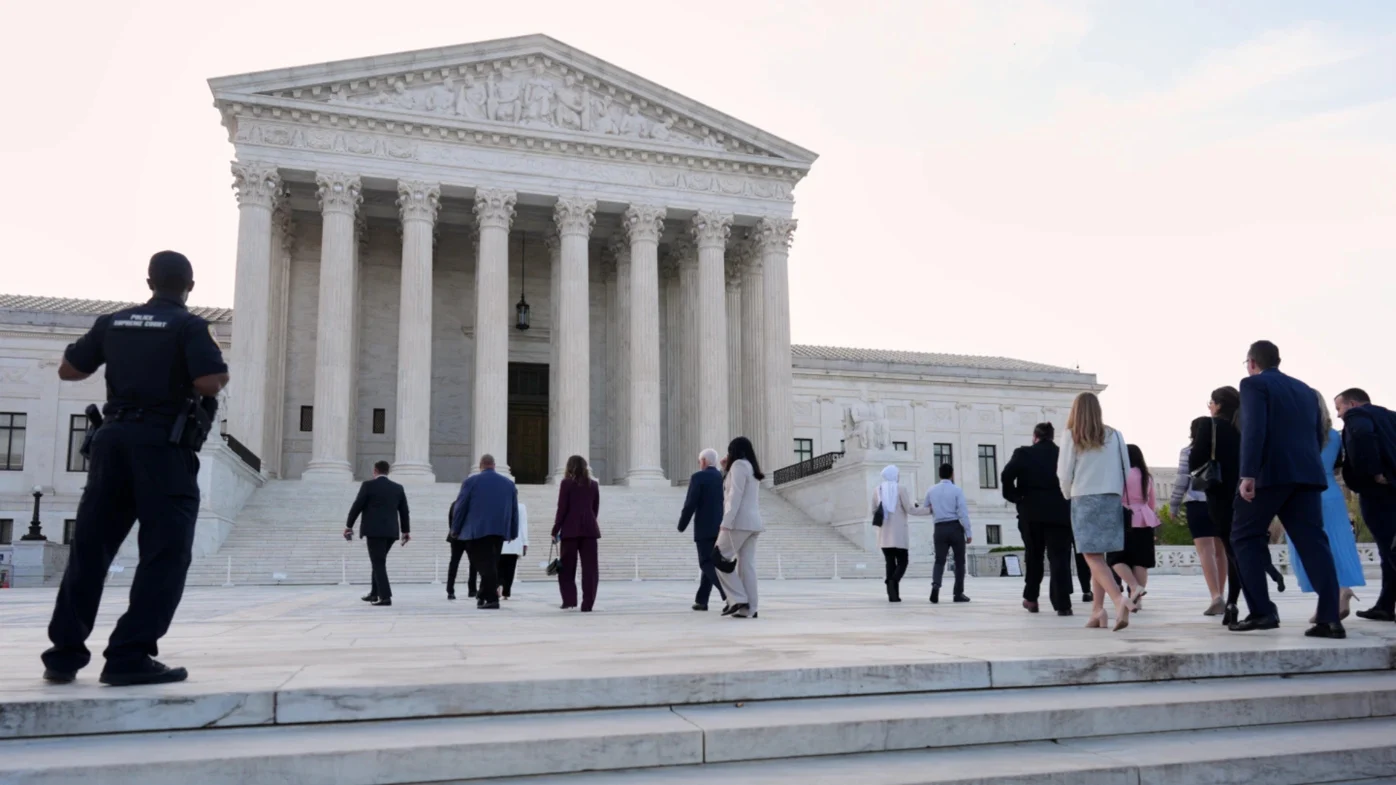
You have probably seen the headline version of this: a major case hits the Supreme Court and suddenly a flood of outside groups “weigh in.” States. Trade associations. Civil rights organizations. Retired judges. Sometimes even members of Congress.
Those filings are usually amicus briefs, short for amicus curiae, Latin for “friend of the court.” And despite the friendly name, they are rarely neutral. An amicus brief is advocacy, just from someone who is not officially a party to the case.
Join the Discussion
What an amicus brief is
An amicus brief is a written argument submitted to a court by a person or organization that is not one of the litigants, but believes the case will affect them or the public. The goal is to help the court decide by offering:
- Additional legal arguments the parties did not emphasize
- Broader context about practical consequences beyond the two litigants
- Expertise in a field the justices are not specialists in, such as medicine, national security, elections, technology, or economics
- Signals about how widely the ruling may matter, including which institutions are watching and why
In the Supreme Court, these briefs are common enough that they have become part of the Court’s normal workflow. In major cases, the amicus briefs can outnumber the briefs filed by the actual parties many times over.
Who can file and how
At the Supreme Court, “anyone” cannot simply drop a brief into the docket whenever they feel like it. Amicus briefs are allowed, but the Court’s rules still control timing, format, and disclosure.
The current rule
As of the Supreme Court’s 2023 changes to Rule 37, most amici do not need the parties’ consent and do not need to file a motion for leave to file. Instead, an amicus generally may file at the cert stage and merits stage as long as the brief is timely and the filer gives notice to the parties.
That does not mean it is a free-for-all. The brief still must follow the Court’s requirements, including:
- Deadlines (amicus briefs are tied to the parties’ filing schedule)
- Formatting and length rules
- Disclosure statements where required, so the justices can see who is backing the brief
In certain situations, different procedures can apply, and the Court can always police abusive or noncompliant filings. But the old default, “get consent or move for leave,” is no longer how most Supreme Court amicus briefs work.
Common amicus filers
- States, usually through state attorneys general
- The United States (often through the Solicitor General)
- Members of Congress (though not speaking for Congress as an institution unless authorized)
- Advocacy organizations on the left and right
- Industry groups and trade associations
- Law professors, former judges, and former government officials
- Local governments and public agencies
Disclosure matters because “outside group” sometimes means a coalition funded by entities with a direct stake in the outcome.
Cert vs. merits
Amicus briefs can show up at two key points in a Supreme Court case, and they play different roles depending on when they arrive.
1) Cert: “Should we take this?”
Before the Supreme Court decides the law, it decides whether to hear the case at all. Most petitions are denied. So at the cert stage, an amicus brief is often about importance.
At this stage, amici try to persuade the Court that the dispute is not just a private fight. They highlight things like:
- National stakes, such as election rules, major regulations, or constitutional rights
- A split among lower courts where different federal circuits disagree
- Real-world disruption if the Court does not step in
- Institutional concerns, such as whether a lower court is defying Supreme Court precedent
Sometimes the most influential cert-stage brief is not from an advocacy group at all, but from the Solicitor General. When the federal government participates as an amicus, the Court pays close attention, in part because the government’s brief can frame the case as administratively urgent or legally clean.
2) Merits: “How should we decide?”
Once the Court grants review, the case moves to the merits stage, where the justices decide who wins and why. Here, amicus briefs are about substance and consequences.
At the merits stage, amici often focus on:
- Doctrinal roadmaps, proposing tests the Court could adopt
- Historical arguments, especially in constitutional cases where text and tradition are central
- Technical facts, like how a technology works or how a medical standard operates in practice
- Line-drawing, warning the Court about unintended spillover effects
If cert-stage amici argue “this case matters,” merits-stage amici argue “here is the rule you should announce, and here is how it will land in the real world.”
What amici do that parties cannot
Even excellent litigants have constraints. They must fight for their client, within a limited record and a limited set of issues. Amici can broaden the lens.
They translate consequences
Courts decide legal questions, but legal questions have aftershocks. An amicus brief can show, concretely, how a rule would change policing, school discipline, religious accommodations, online speech moderation, business compliance, or ballot access.
They supply expertise
The justices are expert generalists. They do not run elections, design software, staff emergency rooms, or administer prisons. Amici can provide context the parties may not prioritize.
They propose workable rules
A Supreme Court opinion often turns on the test it adopts. For example, what triggers strict scrutiny, what counts as a “search,” or when a law burdens speech. Amici can offer standards that aim to be administrable for lower courts.
They lobby the Court in a disciplined way
“Lobby” sounds improper, but it captures the reality that major litigation attracts major stakeholders. Amicus practice is the formal, rule-governed channel for that pressure. It is part of how constitutional law absorbs political and social conflict without pretending the conflict does not exist.

Does volume matter?
It can, but not in the simplistic way people assume.
Volume as a signal
A large number of amicus briefs can act as a visibility signal. It tells the justices that many institutions expect the decision to matter. At the cert stage, that can reinforce the idea that the Court’s intervention is needed.
Volume is not value
The Court is not taking a vote among organizations. Many amicus briefs repeat the same points with different letterhead. In a high-profile case, dozens of briefs may add up to only a few genuinely new ideas.
One strong brief can outweigh fifty weak ones
An amicus brief can be influential if it does at least one of these things well:
- Introduces a clean legal theory that gives the Court a path to rule narrowly
- Offers credible historical evidence that changes how a constitutional question is framed
- Clarifies practical administration for courts and officials who will implement the ruling
The Supreme Court’s modern docket is small, but its cases are high impact. That combination encourages more amici: if a single decision may set national rules, everyone with skin in the game tries to get in the room, even if only through paper.
Are amici evidence?
No. Not in the normal trial sense.
Supreme Court cases are decided on the record developed in the lower courts. Amici can cite studies, history, statistics, and real-world experience, and justices sometimes reference that material. But an amicus brief does not create new trial evidence, and courts are cautious about treating it like it does.
This is one reason amicus briefs tend to focus on context and framing rather than trying to prove disputed facts. A good amicus brief does not pretend to be a new courtroom. It acts more like a spotlight.
How groups pick sides
The “friend of the court” label can be misleading because amici almost always support one party.
Outside groups choose sides for predictable reasons:
- Mission alignment: civil liberties groups back speech claims; religious groups back free exercise claims; unions and business coalitions back labor and regulatory positions
- Precedent management: a group may worry a ruling will weaken a doctrine they rely on, even if they have no connection to the specific litigants
- Future strategy: amici sometimes plant arguments to shape how lower courts read the decision
Amicus briefs can also be written as much for the broader legal audience as for the nine justices. They speak to lower court judges, future litigants, and legislators who will respond to the ruling.
Why this matters
Amicus briefs are a reminder that the Supreme Court is not only an umpire for private disputes. It is a rule-making institution for constitutional meaning, and many actors treat it that way.
If you are trying to understand why a case turned out the way it did, do not stop at the parties’ arguments. Look at who filed amici and what themes they pushed. You can often see the larger constitutional conflict that the case is carrying.
And the next time you read that “outside groups weighed in,” you can translate it: they were not spectators. They were trying to help write the rule that will govern all of us.
Quick definitions
- Amicus curiae: “Friend of the court,” a non-party who files a brief.
- Certiorari (cert): The Supreme Court’s decision whether to hear a case.
- Merits: The stage where the Court decides the case and issues an opinion.
- Solicitor General: The federal government’s top Supreme Court lawyer, whose amicus briefs can be especially influential.