
Join the Discussion
America has two days that celebrate independence. One commemorates the birth of a nation; the other, the liberation of its people. One is the articulation of a promise; the other, the beginning of its painful and long-overdue delivery.
The Fourth of July and Juneteenth are not competing holidays. They are two indispensable parts of the same, complex American story.
One without the other is incomplete, telling either a sanitized story of our ideals or a cynical story of our failures. To understand the U.S. Constitution and the nation it governs, we must hold the meaning of both days at once. It is in the space between the promise of 1776 and the reckoning of 1865 that the true, ongoing story of American liberty is found.
The Promise of 1776: A Declaration of Principle
On July 4, 1776, our founders declared a set of radical, “self-evident” truths: that all men are created equal, endowed with unalienable rights, and that governments derive their power from the consent of the governed.
This was the nation’s birth certificate, a profound statement of principle that has inspired democratic movements across the globe for nearly 250 years.
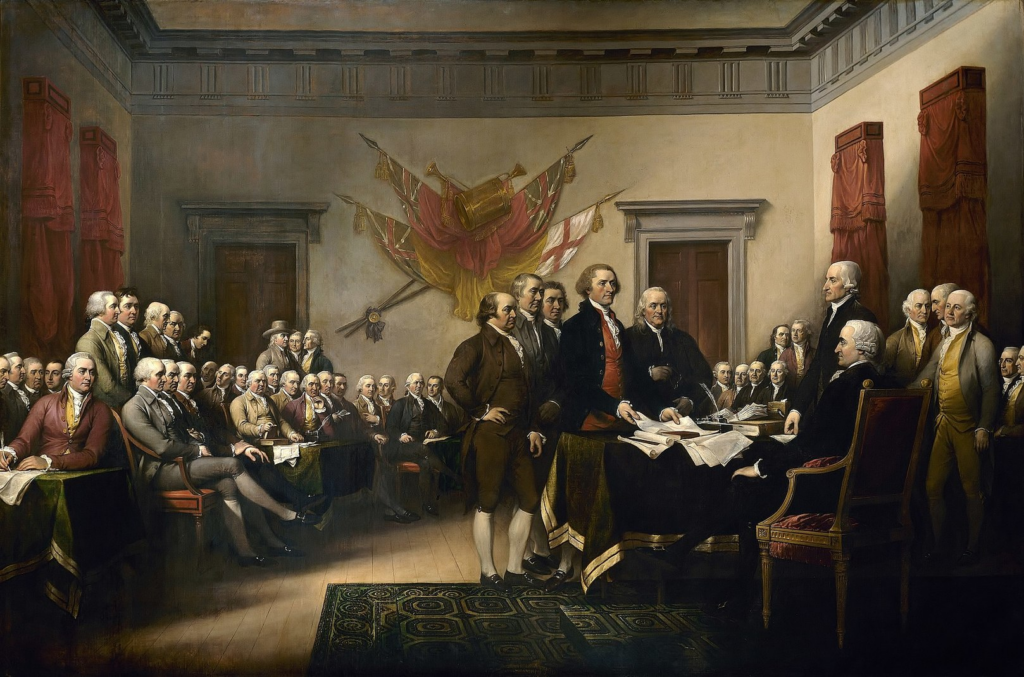
Yet, this noble declaration was written in the shadow of a great constitutional paradox. Many of the men who signed their names to these universal principles of liberty were slaveholders.
The freedom they declared for the nation was not a freedom they extended to the hundreds of thousands of Black people they held in bondage. This was the nation’s original sin, a hypocrisy so profound that it led the great abolitionist Frederick Douglass to ask in 1852,
“What, to the American slave, is your Fourth of July?”
He called it a “hollow mockery,” a celebration of a promise that was, for millions, a lie.
The Reckoning of 1865: A Declaration Delivered
If July 4th was the promise, June 19, 1865, was the beginning of the reckoning.
On that day, two and a half years after the Emancipation Proclamation was signed, and two months after the Civil War had ended, Union Major General Gordon Granger arrived in Galveston, Texas. His message, backed by 2,000 federal troops, announced that all enslaved people were free.

This was not the date that slavery was constitutionally abolished—that would come months later with the ratification of the 13th Amendment. But Juneteenth represents something more visceral: the on-the-ground enforcement of freedom. It marks the moment the promise of the Declaration, a promise that had to be redeemed in the blood of the Civil War, was finally delivered to the last enslaved people in the deepest reaches of the Confederacy. It is a celebration of liberation, resilience, and the beginning of the long, arduous constitutional journey toward equality through the 13th, 14th, and 15th Amendments.
One Nation, Two Independence Days
Given this history, a new question has entered our national discourse: in the spirit of inclusivity, should Juneteenth replace the Fourth of July as America’s primary Independence Day?
To pose the question this way is to present a false choice. It suggests one date must be elevated by diminishing the other. A more constitutionally mature perspective is that the American story is incomplete—and incoherent—without both.
To celebrate July 4th without acknowledging Juneteenth is to honor the ideal without confronting the struggle required to make it real.
It is to admire a beautiful promise while ignoring the fact that it was not kept for millions. Conversely, to celebrate Juneteenth without the context of July 4th is to focus on the struggle without the founding principles that gave it moral and legal power. It was the very language of the Declaration that abolitionists from Frederick Douglass to Martin Luther King Jr. used to call the nation to account.
The power of the American story does not lie in a flawless past. It lies in the tension between our founding ideals and our often-brutal reality. It is the story of a nation constantly striving, and often failing, to close the gap between the two.
A More Perfect Union: Holding Two Truths at Once
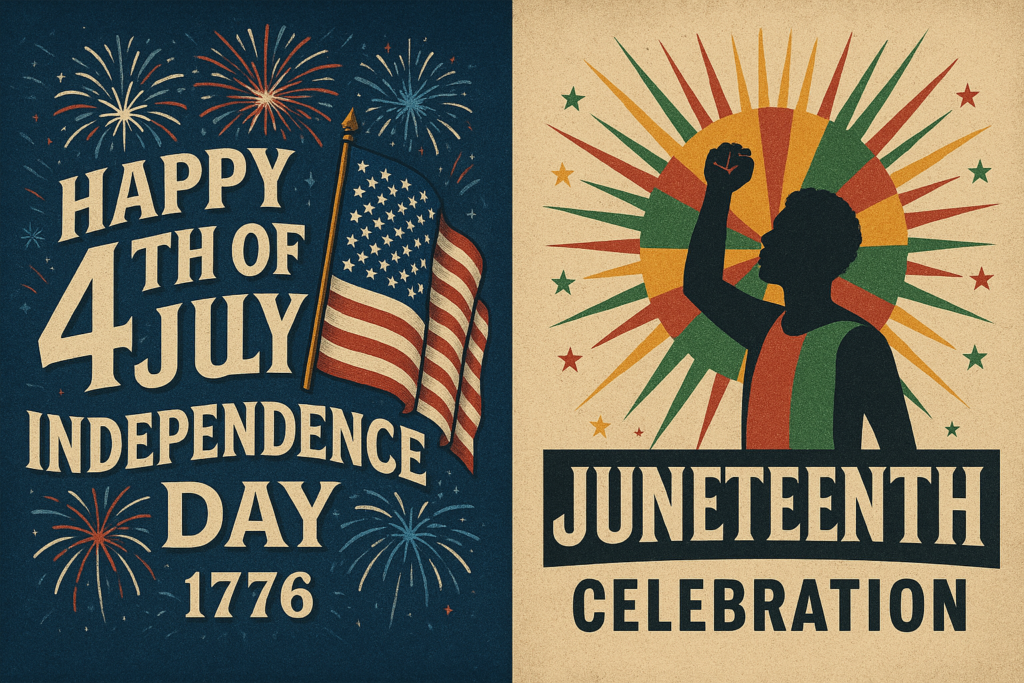
A mature republic must be capable of celebrating both its founding principles and its painful, ongoing struggle to live up to them. The Fourth of July and Juneteenth are not in conflict; they are in a deep and necessary constitutional conversation.
One is the nation’s thesis on liberty; the other is the stark, undeniable antithesis of its failure to apply it.