
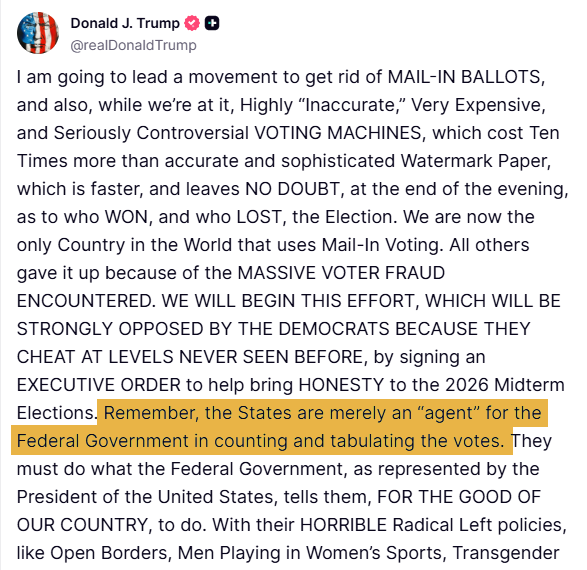
In a social media post on Monday, the President of the United States made one of the most explicit and constitutionally radical claims of his time in office. Announcing a new push against mail-in ballots and voting machines, he declared that the states are “merely an ‘agent’ for the Federal Government” in elections and that they “must do what the Federal Government, as represented by the President… tells them.”
This is not a simple misstatement or a political gaffe. It is a direct and unambiguous assault on the principle of federalism and the plain text of the U.S. Constitution. The statement reveals a constitutional worldview that sees power as entirely centralized in the executive, a view that is profoundly at odds with the design of our republic.
The Constitution’s Clear Command: The Elections Clause
The President’s claim that he can personally direct states on how to run their elections is not a matter of legal interpretation; it is a direct contradiction of the Constitution’s text. Article I, Section 4 – known as the Elections Clause – is explicit:
“The Times, Places and Manner of holding Elections for Senators and Representatives, shall be prescribed in each State by the Legislature thereof…”
The clause goes on to say that Congress may “make or alter such Regulations,” but it gives absolutely no role to the President. The framers deliberately placed the power of election administration in the hands of the states, with the federal legislature as the only potential check. The President’s assertion that states are his “agents” in this process is a “novel take on the Constitution,” to put it mildly.
A Rejection of a Bedrock Principle
What makes the President’s statement so stunning is that it is a complete repudiation of “states’ rights” – a principle that has been a cornerstone of conservative and Republican orthodoxy for generations.
The idea that the federal government is one of limited, enumerated powers and that states should lead the way is central to this philosophy.
The 2016 Republican Party platform, for example, was filled with passionate defenses of state sovereignty.
“Every violation of state sovereignty by federal officials is not merely a transgression of one unit of government against another; it is an assault on the liberties of individual Americans,” the platform read.
The President’s new declaration – that states “must do” what he tells them – is impossible to square with this long-standing principle. It is an open rejection of a core tenet of his own party’s stated ideology.
A Pattern of Centralized Power
While the President’s words were shocking in their bluntness, his actions have long followed this pattern. This statement is the logical conclusion of an administration that has consistently prioritized centralized, federal power over state and local authority whenever the two have come into conflict.
- On immigration, the administration has sued and threatened to defund “sanctuary” states and cities that refuse to comply with its policies.
- On law enforcement, he became the first president in 60 years to deploy troops to a state – California – without the governor’s consent, and he has federalized the police in Washington, D.C.
- On healthcare, his new “megabill” imposes, for the first time, federal “work requirements” for Medicaid, a program administered by the states.

The President’s statement that states are merely his “agents” is not an outlier. It is the verbal expression of a consistent and long-standing governing philosophy.
This leaves the nation, and particularly conservatives, at a constitutional crossroads. The President’s words have stripped away any pretense. His vision of government is not one of states’ rights, but of absolute presidential power. The great constitutional question now is whether his supporters will continue to follow a leader whose vision is so fundamentally at odds with a principle they have claimed to champion for generations.