
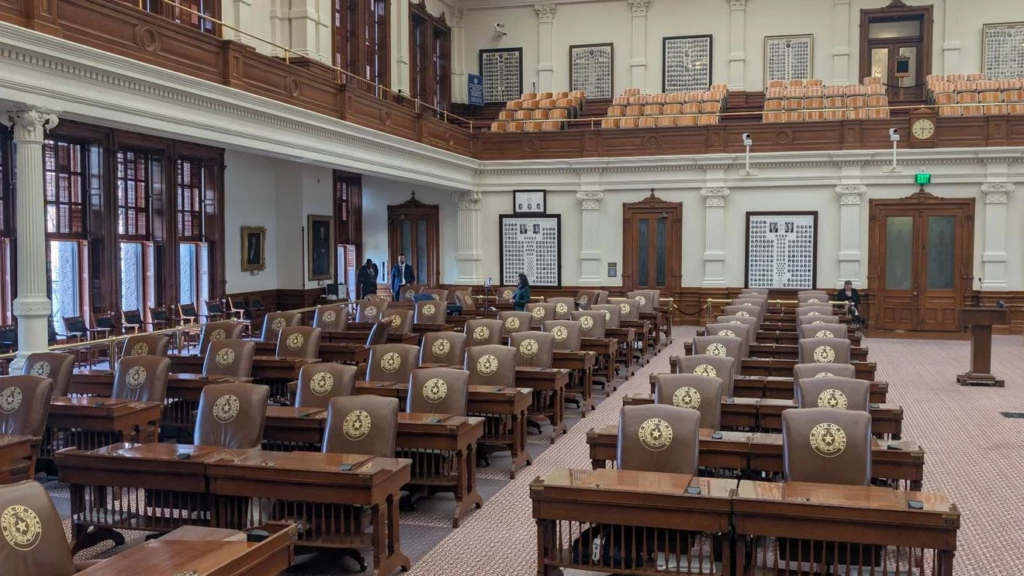
In the dead of night, in the ornate chamber of the Texas House of Representatives, three lawmakers slept on chairs pushed together. They were not homeless, and they were not squatting. They were elected officials engaged in a profound act of protest.
This quiet, overnight vigil, led by State Representative Nicole Collier, is the latest and most personal front in the brutal war over redistricting in Texas – a fight that has now moved beyond the drawing of maps and into a constitutional struggle over rules, rights, and personal dignity.
The Texas House Standoff In A Nutshell
- What’s Happening: Texas State Rep. Nicole Collier slept in the House chamber to protest a new rule from the Republican leadership.
- The Rule: Returning Democrats who broke quorum must agree to a law enforcement escort to leave the House floor. Collier refused to sign the “permission slip.”
- The Protest: She, along with two colleagues in solidarity, is engaging in an act of peaceful resistance against what she calls an “unnecessary” and “demeaning” abuse of power.
- The Constitutional Issue: A clash between a legislature’s constitutional power to compel the attendance of its members and a lawmaker’s First Amendment right to protest what they see as an unjust rule.
A Protest of ‘Permission Slips’
The drama began the moment the quorum-busting Democrats returned to the state capitol on Monday. The Republican leadership, determined to prevent another walkout, instituted a new, extraordinary rule.
Any of the returning Democrats who wished to leave the House floor – even for a meal or a restroom break – would first have to sign a form agreeing to be placed in the “custody” of a Texas Department of Public Safety officer who would serve as a constant escort.
Rep. Collier refused.
“Look, I’m not a criminal. I’ve exercised my right, and I am tired of the government controlling our movement… It’s demeaning to me as a person and to my community, and I just won’t take it.” – Rep. Nicole Collier
Instead of signing what she called a “permission slip,” she chose to remain in the chamber, effectively confining herself to the House floor as an act of protest.
‘Good Trouble’ in the Texas House
Overnight, Rep. Collier was joined by two of her Democratic colleagues, Reps. Gene Wu and Vince Perez, who slept in nearby chairs in solidarity.
Rep. Wu, who had signed the form himself, explicitly framed their action in the hallowed tradition of the civil rights movement, posting on social media that he was supporting Collier’s “#goodtrouble” – a direct reference to the late Congressman and civil rights icon John Lewis.
By invoking Lewis, the lawmakers are deliberately casting their protest not as a mere procedural squabble over House rules, but as a moral and political stand against what they view as an unjust and authoritarian system.

A Legislature’s Power to Police Itself
This entire conflict is a fascinating and raw display of a legislature’s constitutional power to police itself.
The Texas State Constitution, like the U.S. Constitution, gives the legislative chamber the authority to “compel the Attendance of absent Members.” The Republican leadership’s escort mandate, while extreme, is an exercise of this broad constitutional power, designed to ensure the House can maintain a quorum and conduct business.
Rep. Collier’s protest, however, invokes other constitutional principles. Her stand is a powerful act of First Amendment-protected political speech. Her framing of the issue as “the government controlling our movement” is a powerful echo of the Fourth Amendment’s protection against unreasonable seizures.
“This is a fascinating constitutional clash. The Republican leadership is wielding a legitimate power to compel attendance, but the manner in which they are doing it is being challenged by Rep. Collier as an infringement on her fundamental rights as a citizen.”
The Battle After the Battle
The Democrats have lost the war to stop the redistricting bill from coming to a vote. Their return has guaranteed that the Republican-drawn maps will now pass.
But Rep. Collier’s defiant stand shows that the fight is not over. The battle has now shifted from a legislative strategy (quorum-busting) to a moral and public relations one.
Her protest is designed to highlight what she sees as the punitive and demeaning nature of the majority party’s rule. While the passage of the maps may be inevitable, this final, personal act of “good trouble” is a powerful closing statement in a fight that will now move from the state capitol to the federal courts.