
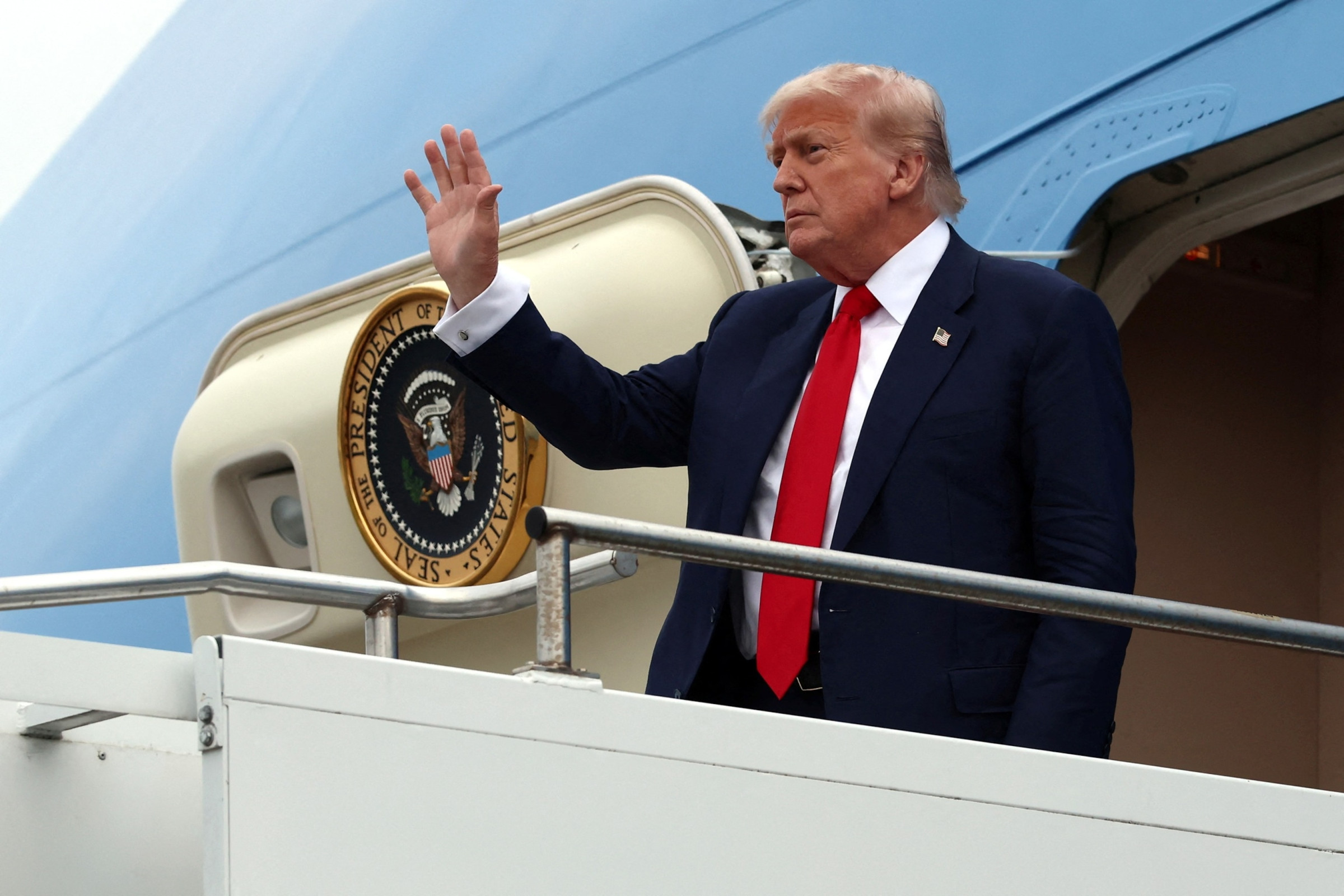
Speaking from Scotland on Friday, President Trump issued a dire and explicit warning to the leaders of Europe. He declared that mass immigration is a “horrible invasion” that is “killing Europe,” and urged the continent to “get your act together” before it is too late.
The President’s words are a powerful expression of a political viewpoint, but they are more than that. The term “invasion” is not just a political insult; it is a word with profound constitutional and legal significance. In a world grappling with unprecedented levels of migration, it is a civic duty to look past the rhetoric and critically examine the facts on the ground.
We must analyze what this language means, whether it reflects reality, and what the constitutional consequences are when a president redefines a policy challenge as an existential war.
A Tale of Two Borders: Examining the Numbers
The President contrasted Europe’s situation with his own success, stating, “last month we had nobody entering our country. Nobody. Shut it down.”
While the claim of “nobody” is rhetorical hyperbole, the underlying trend is factual.
Since the implementation of his administration’s sweeping executive orders, illegal crossings at the U.S. southern border have plummeted from the highs seen under the previous administration to the lowest levels in decades.
He then pointed to Europe as a cautionary tale. Let’s look at the numbers. The United Kingdom has seen nearly 22,500 migrants arrive in small boats so far this year, a significant increase from the same point last year. The continent as a whole is dealing with a complex and challenging migration crisis.
However, to label this a crisis that is “killing” the continent is a dramatic overstatement. Europe has a population of roughly 750 million people. While the influx of migrants presents serious logistical and political challenges, the numbers do not support the language of an existential threat.
The President is using the most inflammatory terms possible to describe a difficult but manageable policy problem.
The Constitutional Danger of Redefining “Invasion”
This is where the rhetoric becomes constitutionally dangerous. “Invasion” is a specific term in the U.S. Constitution. Article IV, Section 4—the Invasion Clause—states that the federal government shall protect each of the states “against Invasion.”
This clause has always been understood to mean a hostile, armed attack by a foreign power, not a migratory phenomenon.

By deliberately and repeatedly using this constitutionally-loaded word to describe the movement of migrants, the President is attempting to reframe a civil immigration issue as a military one. This is a perilous redefinition.
If a president can unilaterally declare a flow of unarmed migrants to be an “invasion,” it could be used to justify an unprecedented expansion of executive power.
It could become a pretext for deploying the U.S. military on American soil for domestic law enforcement, bypassing the constraints of the Posse Comitatus Act and fundamentally altering the relationship between the military and the citizens it is sworn to protect.
The Diplomatic Echoes of “Killing Europe”
The President’s warning that immigration is “killing Europe” is equally fraught. Standing on allied soil, the leader of the free world is using language that echoes the “Great Replacement,” a conspiratorial theory popular in far-right circles that claims non-white immigrants are being deliberately imported to “replace” the native-born European population.
This is a profound break from diplomatic norms. It is a public admonishment of our closest allies and an alignment with Europe’s most extreme nationalist figures, like Hungary’s Viktor Orbán.
It injects a toxic and racially charged ideology into the heart of international diplomacy, undermining the very leaders the U.S. relies on for global stability.

The President’s words in Scotland were not off-the-cuff remarks. They were a deliberate deployment of constitutionally significant and ideologically charged language. While the debate over how to manage immigration is one of the most difficult challenges facing Western democracies, the language we use to conduct that debate matters immensely.
To reframe a policy problem as an “invasion” or a threat of demographic extinction is to abandon reasoned debate in favor of existential fear, with dangerous and unpredictable consequences for the rule of law and the stability of the free world.