
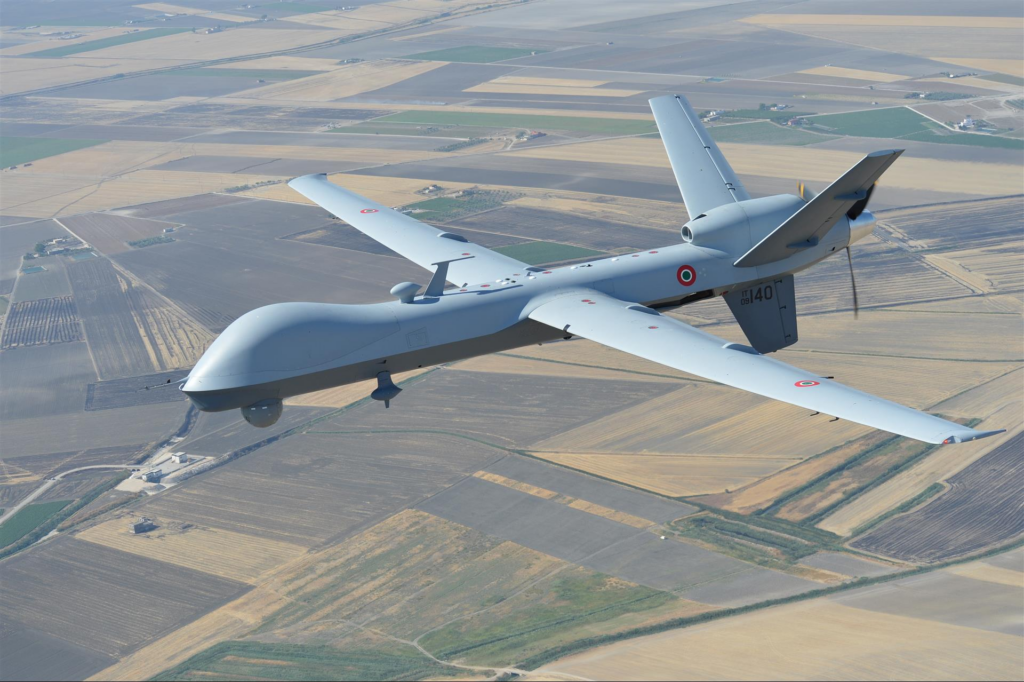
An MQ-9 Reaper drone is a weapon of war. It is a hunter-killer aircraft, designed to circle for hours over the battlefields of Afghanistan and Iraq, providing surveillance and delivering lethal force. The revelation that this piece of military hardware was reportedly used by the Department of Homeland Security to monitor American citizens protesting in an American city is a deeply alarming development that strikes at the heart of our constitutional order.
In response, Representative Jimmy Gomez of California has introduced legislation to ban this practice. While his bill is unlikely to pass in the current Congress, its introduction forces an urgent and necessary national debate.
It is a test of whether our 18th-century rights to privacy and assembly can protect us from the all-seeing eye of 21st-century military surveillance technology.
A Weapon of War in a Domestic Dispute
The use of these drones occurred in the context of the contentious anti-ICE protests that rocked Los Angeles last month. The Trump administration’s aggressive response to that civil unrest, which included deploying the National Guard over the governor’s objections, has already raised serious constitutional questions.
The reported use of a Reaper drone, however, represents a qualitative leap. This is not a simple police helicopter providing a bird’s-eye view. The MQ-9 is a sophisticated military-grade surveillance platform, capable of persistent, high-altitude monitoring with powerful sensors.
To deploy such a tool, designed for foreign adversaries, against a domestic protest is to fundamentally redefine the relationship between the government and its citizens.
The Fourth Amendment in the Age of the Drone
This new form of surveillance poses a direct challenge to the Fourth Amendment, which protects the right of the people to be secure against “unreasonable searches.” Historically, courts have held that there is little expectation of privacy in a public space.
But that precedent was established long before the advent of technology that allows the government to persistently monitor every movement of a large crowd for hours on end.
The critical constitutional question is whether the use of a military-grade drone constitutes a qualitatively different—and therefore “unreasonable”—level of search that our founders never could have envisioned. It is a legal frontier where our technology is rapidly outpacing our law. As Rep. Gomez stated,
“The U.S. government should never use military drones to spy on its own people. Not under Trump. Not under anyone.”

The Spirit of Posse Comitatus
Beyond the Fourth Amendment, this action violates the spirit of one of America’s oldest and most important legal traditions: the separation of the military from domestic law enforcement. The Posse Comitatus Act of 1878 was passed to prevent the federal government from using the U.S. Army to police its own citizens.
The principle is clear: soldiers are not police officers.
Even if the drone is operated by a civilian agency like DHS, the use of a military weapon system for domestic surveillance shatters this principle. It treats American citizens engaged in protest—a constitutionally protected right under the First Amendment—as if they are enemy combatants on a foreign battlefield.
This is a dangerous and corrosive shift.
The presence of such a tool in the skies above a protest can create a powerful “chilling effect,” deterring law-abiding citizens from exercising their right to free assembly for fear of being monitored by a weapon of war.
While Rep. Gomez’s bill may be symbolic for now, it is a vital symbol. The technologies of war are advancing at a breathtaking pace. Our constitutional republic can only survive if our commitment to our founding principles—privacy, free assembly, and a clear line between soldier and police officer—keeps pace.
The image of a combat drone in the skies above an American city is a stark warning that we are in danger of losing that race.