
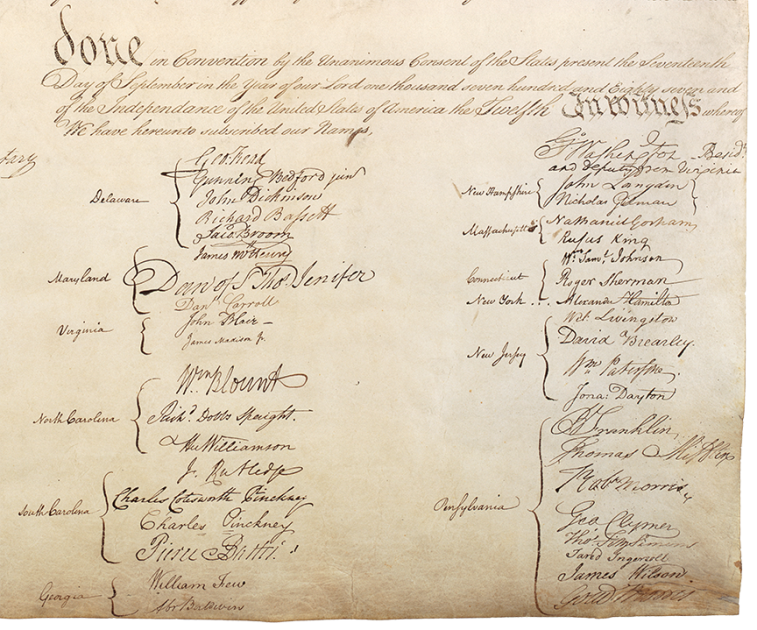
This week, America marks the 238th anniversary of the signing of its most sacred civic document. In a new presidential proclamation, the U.S. Constitution is hailed as a “legendary charter” that codified “eternal truths.”
But the story of the Constitution’s birth in the hot, stuffy summer of 1787 is not one of serene consensus. It is a dramatic and often bitter story of argument, political calculation, and hard-won compromise among deeply divided founders.
Looking back at that contentious creation provides a powerful and necessary context for understanding the fierce constitutional debates of our own time.

At a Glance: Constitution Week 2025
- What’s Happening: President Trump has issued a proclamation for Constitution Week, celebrating the 238th anniversary of the document’s signing on September 17, 1787.
- The President’s Message: The proclamation frames the Constitution as a divinely inspired charter and links its principles to his administration’s policies on citizenship, education, patriotism, and religion.
- The Historical Context: The actual creation of the Constitution was not a moment of pure consensus, but one of intense debate and difficult compromise over the very nature of power, representation, and freedom.
- The Constitutional Issue: The proclamation highlights the ongoing and often fierce debate over the Constitution’s original meaning, pitting a vision of immutable, God-given truths against the historical reality of a practical document born from political struggle.

A ‘More Perfect Union’ Forged in Conflict
The 55 delegates who gathered in Philadelphia in 1787 were not in agreement. The nation they had created under the Articles of Confederation was failing, and they were deeply divided on how to fix it.
The document they produced was not a work of divine inspiration, but of political desperation and compromise.

The “Great Compromise” saved the convention from collapse, settling a bitter fight between large and small states over representation by creating our two-chambered Congress – the House based on population, and the Senate with equal representation for every state.
The most painful compromise, the nation’s original sin, was the “Three-Fifths Compromise,” which agreed to count three-fifths of the enslaved population for the purposes of representation. It was a dark, pragmatic bargain made to convince the southern states to join the new union.
“The Constitution was not delivered from on high; it was hammered out in a room full of brilliant, flawed, and deeply divided men who were trying to save a failing nation from collapse.”
The President’s Vision: A Charter of Conviction
In his Constitution Week proclamation, President Trump presents a different vision. He frames the Constitution as a document that “codified the timeless truth… that the rights to life, liberty, and the pursuit of happiness are granted not by government, but by God.”
He connects this vision of an immutable, sacred charter directly to his administration’s policy agenda, citing his executive orders to:
- “Protect the Meaning and Value of American Citizenship.”
- Shut down all federal “Diversity, Equity, and Inclusion” (DEI) programs.
- Promote a specific version of American history in schools and museums to fight back against “left-wing arsonists.”
- Prosecute those who desecrate the American flag.

A Clash with Precedent
The President’s vision, and the policies that flow from it, at times exist in tension with how the Constitution has been interpreted by the courts for generations.
The most direct example is his call to prosecute those who desecrate the flag. While this is a powerful and popular political stance, the Supreme Court has repeatedly ruled that flag burning is a form of political protest protected by the First Amendment.
In the landmark 1989 case Texas v. Johnson, the Court found that the government cannot prohibit “expression of an idea simply because society finds the idea itself offensive or disagreeable.”
“This highlights a core constitutional tension: a President’s call to defend the flag as a sacred symbol runs directly into a Supreme Court precedent that protects the right to desecrate that same flag as an act of political protest.”
An Enduring Debate
This week’s celebration of the Constitution highlights the central and enduring argument of American life.
The President’s proclamation presents the Constitution as a finished, perfect work – a sacred text to be revered and defended against those who would “defile” it.
The historical reality shows it as a practical, imperfect, and adaptable document born of human struggle, designed not to be perfect, but to allow for the creation of a “more perfect Union” over time.
This debate – between the Constitution as a sacred text and the Constitution as a living framework – is what drives our politics. The anniversary of its signing is a powerful reminder that the work of fulfilling its promises is, and always has been, an unfinished project.