
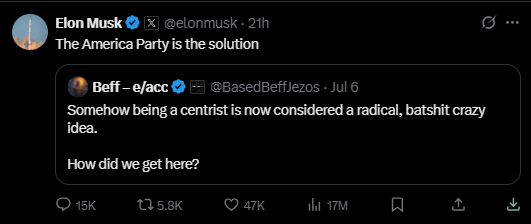
Following a public feud with President Trump over government spending, Elon Musk—the world’s richest man—has declared the formation of a new political party. He calls it the “America Party,” and claims it will represent the “80%” of Americans in the political middle and “give you back your freedom.”
The idea is undeniably popular. Polls consistently show a deep frustration with both Republicans and Democrats and a strong desire for a third option.
But while the desire is real, the history of our constitutional republic and the very structure of our political system present a series of nearly insurmountable obstacles.
This is not a matter of money, fame, or ambition; it is a matter of political physics. The promise of a new party is easy to make, but the reality is one of the most difficult paths in American politics.
The Winner-Take-All Gauntlet
The primary reason third parties fail in the United States is the structure of our electoral system. Unlike many parliamentary democracies where a party can gain seats with 15% or 20% of the vote, the U.S. employs a “winner-take-all” system in virtually every federal election.
In a congressional district, the candidate who gets the most votes wins, and everyone else gets nothing.
This creates a powerful psychological and strategic barrier. As billionaire Ross Perot discovered in 1992, even winning a stunning 19% of the popular vote for president yields zero electoral votes.
Voters, understanding this, are reluctant to “waste” their vote on a third-party candidate with little chance of winning. Instead, they are forced to make a pragmatic choice between the two major parties, even if they dislike both.
This structural reality, more than any other factor, relentlessly squeezes third parties out of existence.
The Labyrinth of Ballot Access
Before a single vote can be cast, a new party faces a daunting logistical challenge: getting on the ballot. There is no single, national ballot.
The “America Party” would need to navigate a labyrinth of 50 different sets of state laws, each with its own petition signature requirements, deadlines, and residential rules.
This is a monumental and costly undertaking. Even established third parties with decades of experience, like the Libertarian and Green parties, routinely fail to achieve 50-state ballot access in a presidential cycle. While Musk’s immense wealth could certainly fund a massive signature-gathering operation, it is a brutal, state-by-state ground war that has thwarted many movements before they could even begin.

Kingmaker or Spoiler? A Question of Strategy
Musk’s stated strategy is not to win the presidency, but to act as a kingmaker. He aims to target a handful of key House and Senate races where, given the “razor-thin legislative margins,” his candidates could become the “deciding vote on contentious laws.”
While this sounds plausible in theory, history offers a sobering lesson on the role of third parties: they are far more likely to be “spoilers” than kingmakers. The most famous modern example is Ralph Nader’s Green Party run in 2000, which many argue drew enough votes from Al Gore in Florida to hand the election to George W. Bush.
The critical question for Musk’s anti-spending, libertarian-leaning party is: from which major party would it pull more votes?
It is highly likely that an “America Party” candidate would draw more support from disaffected, fiscally conservative Republicans than from Democrats. In a close race, this could have the unintended consequence of splitting the center-right vote and helping to elect the very “Porky Pig Party” Democrats that Musk opposes.
The enduring power of the two-party system is not a conspiracy; it is a direct result of our constitutional design. While the desire for a third way is a potent symbol of the deep dissatisfaction within the American electorate, history and the fundamental rules of our government suggest a perilous road ahead for the “America Party.”
To succeed would require more than just a new party; it would require changing the very structure of the game that has governed our republic for over 200 years.