The transition of power in Richmond has moved with a speed that has left the Commonwealth’s political establishment breathless. Within hours of her inauguration, Governor Abigail Spanberger moved to dismantle years of Republican policy, triggering a fierce debate over whether her “moderate” campaign was a principled promise or a tactical mask.

The Identity Crisis of the Virginia Executive
The dilemma currently unfolding in Virginia is a classic study in the tension between campaign rhetoric and governing reality. For months, Abigail Spanberger presented herself as a pragmatic centrist, frequently citing her background as a CIA officer and the daughter of a law enforcement official to reassure voters in the suburban “swing” districts.

Yet, the “radical laundry list” of her first day in office has led critics to argue that the moderate label was discarded the moment the ink dried on the election certification.
Among the most controversial moves was the immediate rescission of Executive Order 47, a directive from former Governor Glenn Youngkin that required state and local police to cooperate with federal immigration officials.
By “icing out” federal authorities, Spanberger is asserting a theory of state sovereignty that focuses exclusively on community policing, but her opponents see it as an abandonment of the rule of law.
This pivot raises a fundamental question about the health of our representative system: Does a candidate have a constitutional duty to adhere to the persona they projected to the electorate, or does the win itself grant a total license to govern from the flank?
This “promissory representation” is the glue that holds the democratic contract together, and when it dissolves, the resulting cynicism can be corrosive to the civic fabric.
Campaigning in Poetry, Governing in Prose
History is littered with leaders who found that the requirements of power bore little resemblance to the promises of the trail. One of the most famous examples of this friction occurred in 1988, when Vice President George H.W. Bush looked into a camera and famously declared,
“Read my lips: no new taxes.”

- 1988: Bush wins a landslide victory based on a pledge of fiscal conservatism and no tax hikes.
- 1990: Facing a massive deficit and a Democratic Congress, Bush breaks his pledge in the Budget Enforcement Act.
- 1992: The perceived betrayal costs him a second term, proving that while “pivoting” may be effective for policy, it is often fatal for political trust.
Governor Spanberger is currently testing whether she can survive a similar backlash. While she ran on an affordability message, her legislative allies have moved with lightning speed to introduce a series of tax increases.
These include new levies on investment income, services like dry cleaning and landscaping, and even a targeted 11% tax on firearms.
This is where the constitutional stakes become clear: when the government changes the rules of the game so significantly and so quickly, it risks losing the “consent of the governed.”
Dismantling the Scales of Justice
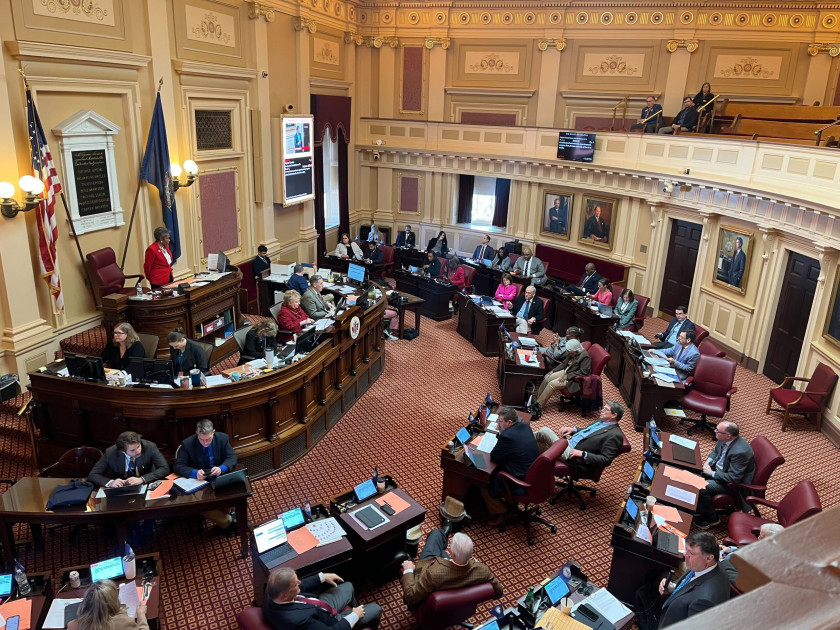
Beyond the executive orders, the new Democratic trifecta in the General Assembly is moving to overhaul Virginia’s criminal justice system. A series of bills aiming to eliminate mandatory minimum sentences for violent crimes – including rape, manslaughter, and assaulting a law enforcement officer – has sent shockwaves through the Commonwealth’s legal community.
Proponents argue that mandatory minimums strip judges of their discretion and lead to inequitable outcomes. However, the outgoing Attorney General has warned that removing these “floor” requirements for repeat violent offenders is a bridge too far for a state that prides itself on public safety.
The controversy highlights a deeper philosophical divide: Is the purpose of the law to provide uniform, predictable consequences, or should it be a flexible instrument of social reform?
- DEI Set-Asides: A new bill targets a goal of 42% of government contracts under $100,000 for minority and women-owned businesses.
- Abortion Amendment: The legislature has fast-tracked a constitutional amendment to enshrine “reproductive freedom,” which critics fear would permit late-term procedures without parental involvement.
- Electoral Changes: New proposals to end hand-counting of ballots and implement a redistricting plan that could give one party a 10-1 advantage in future elections.
The “Fairfaxing” of the Commonwealth
The phrase “Fairfaxing the rest of Virginia” has become a rallying cry for the opposition. It refers to the fear that the progressive policies of Northern Virginia – which often diverge sharply from the rest of the state’s traditional values – are being forcibly exported to the Blue Ridge and the Tidewater regions.
The move to rejoin the Regional Greenhouse Gas Initiative (RGGI) is a prime example of this tension. Spanberger argues that rejoining the pact will lower costs and fund flood mitigation, but Republicans contend it is effectively a carbon tax that will be passed directly to the consumer’s utility bill.
For the constitutional watchdog, this represents a shift toward administrative governance, where executive agencies gain more power to regulate the lives of citizens through indirect taxation.
“She’s been in office like 6 hours and is already trying to turn Virginia into Minneapolis,” noted Meghan McCain, highlighting the national perception that Virginia is undergoing a rapid, systemic transformation that was never explicitly telegraphed to the “low-information” voters of the campaign trail.
A Constitutional Collision Course
Ultimately, the Spanberger administration is betting that the voters will prioritize results over rhetoric. If the Governor can successfully lower housing costs – a key goal of her first three executive orders – she may be forgiven for her “bait and switch” on social and fiscal policy.
However, the Supremacy Clause and the Tenth Amendment continue to loom over this transition. As Virginia withdraws its support for ICE and shifts its legal opinions on in-state tuition for undocumented residents, it sets itself on a collision course with the federal government’s current immigration priorities.
This friction is not merely a policy dispute; it is a fundamental test of the separation of powers between the state house and the White House.
The coming months will determine if Virginia remains a “purple” state of moderated compromises or if it has entered a new era of unbridled progressive activism. The lesson remains consistent: the Constitution provides the framework for power, but it is the integrity of the campaign promise that provides the legitimacy.