
“Donald Trump, you have poked the bear and we will punch back,” California Governor Gavin Newsom recently declared. The “punch” he is proposing is a plan to dismantle his own state’s celebrated, voter-approved independent redistricting commission in order to draw a new, partisan gerrymander to favor Democrats.
The stated reason for this move is to “fight fire with fire” against a similar Republican effort in Texas. But this raises a profound constitutional and ethical question: Can you defend democracy on a national level by abandoning its principles at home?
This high-stakes gambit is a powerful case study in the corrosive logic of partisan warfare and a test of whether a good-government reform can survive when it becomes politically inconvenient.
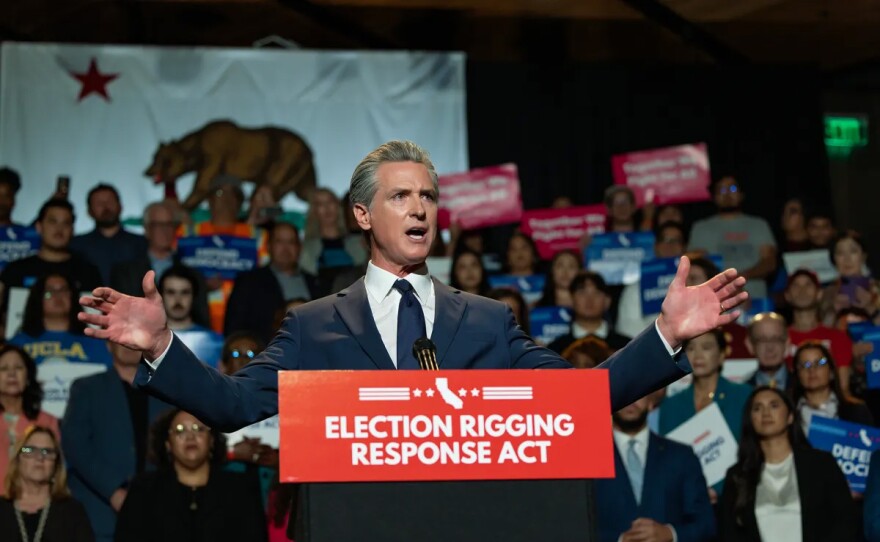
The Logic of Retaliation
The governor’s argument is one of pragmatic, hardball politics. With the control of the U.S. House of Representatives on a knife’s edge ahead of the 2026 midterms, he contends that California cannot afford to be unilaterally disarmed.
As Republicans in Texas move to create up to five new GOP-friendly seats through an aggressive gerrymander, Newsom argues that a “proportional response” is necessary.
This argument, however, ignores a critical piece of context. The practice of partisan gerrymandering is a bipartisan sin. Democrats have benefited from the notorious computer-drawn maps in states like Illinois and Maryland.
This reality complicates the narrative that California’s move is a purely defensive reaction to Republican aggression, rather than another escalation in a national political arms race.
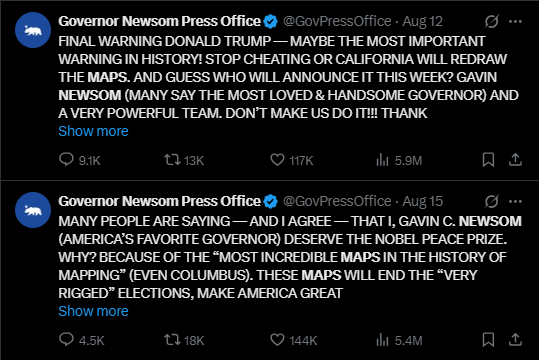
The Independent Commission
What makes Newsom’s proposal so constitutionally significant is that he is seeking to override a landmark democratic reform that was passed directly by the people of his state.
In 2008 and 2010, California voters, led by a bipartisan coalition that included then-Governor Arnold Schwarzenegger, passed propositions to strip partisan legislators of the power to draw their own districts.

They created an independent Citizens Redistricting Commission to ensure that voters choose their representatives, not the other way around. Now, the governor is asking those same voters, via a special referendum, to temporarily suspend their own creation for the sake of national politics. The early signs suggest a difficult fight; a recent poll shows that two-thirds of Californians oppose the plan.
The Unspoken Demographic Reality
Beneath this political battle lies a deeper, more powerful trend that could render this entire fight moot. While politicians in Sacramento and Austin are fighting over how to slice up the electoral pie, the pie itself is shrinking in one state and growing in the other.
California is hemorrhaging population. According to recent IRS migration data, the state is losing hundreds of thousands of residents and billions of dollars in taxable income, while Republican-led states like Texas and Florida are the primary beneficiaries.
This demographic shift means that California is on track to lose multiple congressional seats after the 2030 census, while Texas and Florida are set to gain them.
This is the unspoken reality of the redistricting wars. In the long run, Democratic gerrymandering in California cannot make up for the demographic consequences of the state’s complex economic challenges, including a high cost of living, a severe housing shortage, and a heavy tax burden.
Governor Newsom’s gambit is a cautionary tale about the corrosive logic of “fighting fire with fire.” When a state’s leaders decide to abandon their own proclaimed principles of fair representation to gain a partisan advantage, they may win a temporary political victory.
But the long-term cost is a further erosion of public faith in the democratic process itself, leaving the entire constitutional “house” more susceptible to the blaze.