
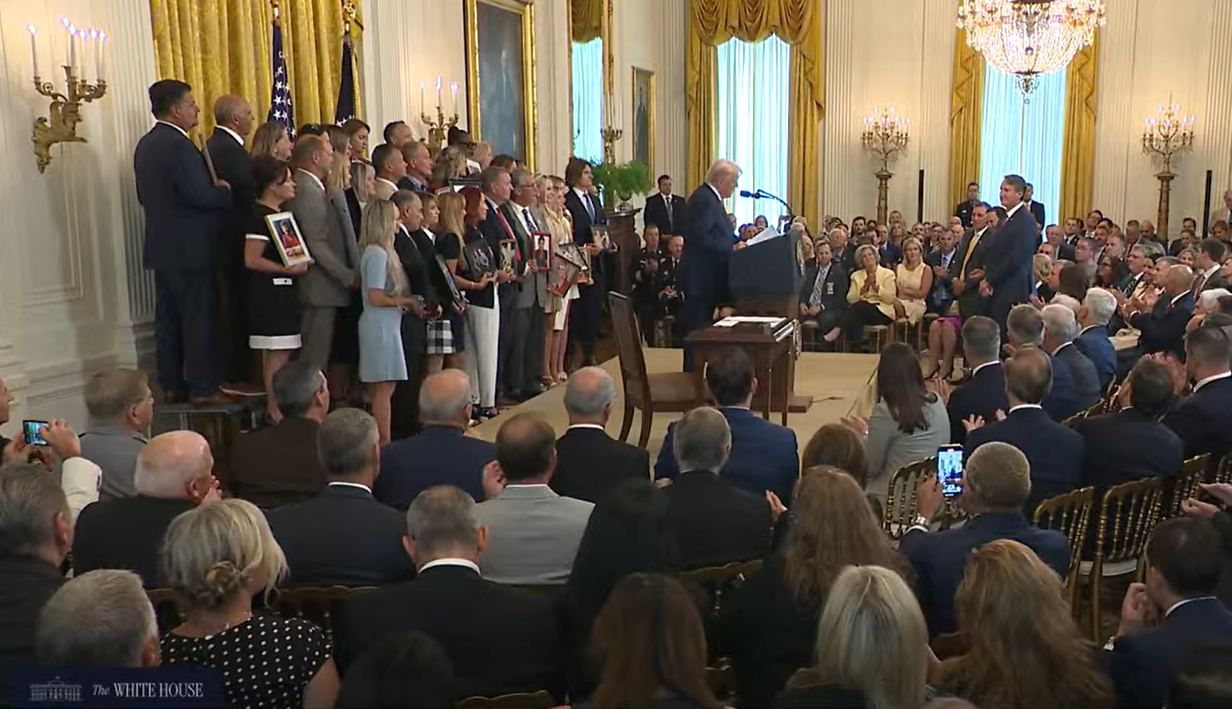
In a rare moment of bipartisan unity, President Donald Trump on Wednesday signed the HALT Fentanyl Act into law, surrounded by congressional leaders and the families of Americans who have lost their lives to this synthetic poison. The new law represents a powerful and long-overdue step in the federal government’s war against the fentanyl epidemic that has devastated communities across our nation.
While the bill received broad support, its passage brings a classic American legal debate into sharp focus: what is the right constitutional balance between a tough, law-and-order response to a deadly crisis and the rights of the accused?
In the face of a poison that is killing tens of thousands of citizens, this law argues for a forceful and constitutionally sound exercise of federal power.
Closing a Deadly Loophole
The primary function of the HALT Fentanyl Act is to close a dangerous legal loophole that has been exploited by foreign cartels. For years, criminal chemists have been able to evade federal law by slightly altering the chemical structure of fentanyl, creating “copycat” substances that were not technically illegal until the government could complete a lengthy scheduling process.
This new law ends that deadly game.
It permanently places all current and future fentanyl-related substances (FRS) onto Schedule I of the Controlled Substances Act, the category reserved for the most dangerous drugs with no accepted medical use.
As the White House explained, this move makes it easier for law enforcement to prosecute traffickers, ensuring that anyone who imports or manufactures any illicit FRS will face the full force of federal law.
The Constitutional Power to Act
The federal government’s authority to pass a law like this is firmly rooted in the Constitution. Article I, Section 8 grants Congress the power “To regulate Commerce with foreign Nations, and among the several States.”
Since illicit fentanyl is overwhelmingly manufactured in foreign countries like China and trafficked into our country by Mexican cartels, it is unequivocally a matter of foreign and interstate commerce, placing it squarely within federal jurisdiction.

This is not a question of federal overreach. It is a necessary exercise of the federal government’s power to protect the nation from a foreign commercial threat that has become a public health and national security crisis. The Constitution was not designed to render the government powerless in the face of such a clear and present danger.
A Sobering Debate: Punishment and Proportionality
Any law that strengthens criminal penalties will inevitably spark debate, and the HALT Fentanyl Act is no exception. Critics raise legitimate concerns that classifying all fentanyl-related substances as Schedule I drugs will trigger harsh, mandatory minimum sentences.
They argue this could ensnare low-level drug users caught up in the trafficking chain, rather than just the kingpins who profit from this trade.
This concern, rooted in the Eighth Amendment’s protection against cruel and unusual punishment, is a valid part of our national conversation on criminal justice.
However, this debate must be weighed against the horrific reality of the crisis itself. What is the proportional response to a chemical weapon disguised as a drug that has killed hundreds of thousands of Americans?
The first and most essential duty of a government, as outlined in the Constitution’s preamble, is to “provide for the common defense” and “promote the general Welfare.” This includes defending its citizens from the chemical warfare being waged against them by foreign criminal organizations.
While our justice system must always strive for fairness, it cannot be paralyzed by a debate over sentencing when faced with an ongoing, mass-casualty event.

The HALT Fentanyl Act is a declaration that the well-being of the American people is paramount. It reflects a bipartisan consensus that this crisis is a national security threat that requires a powerful and unified response. While the important work of criminal justice reform continues, it cannot come at the expense of the government’s primary duty to protect its citizens from a poison that is killing them by the tens of thousands.
In a crisis of this magnitude, the Constitution does not demand hesitation; it empowers our government to act decisively to defend the lives of the American people.