
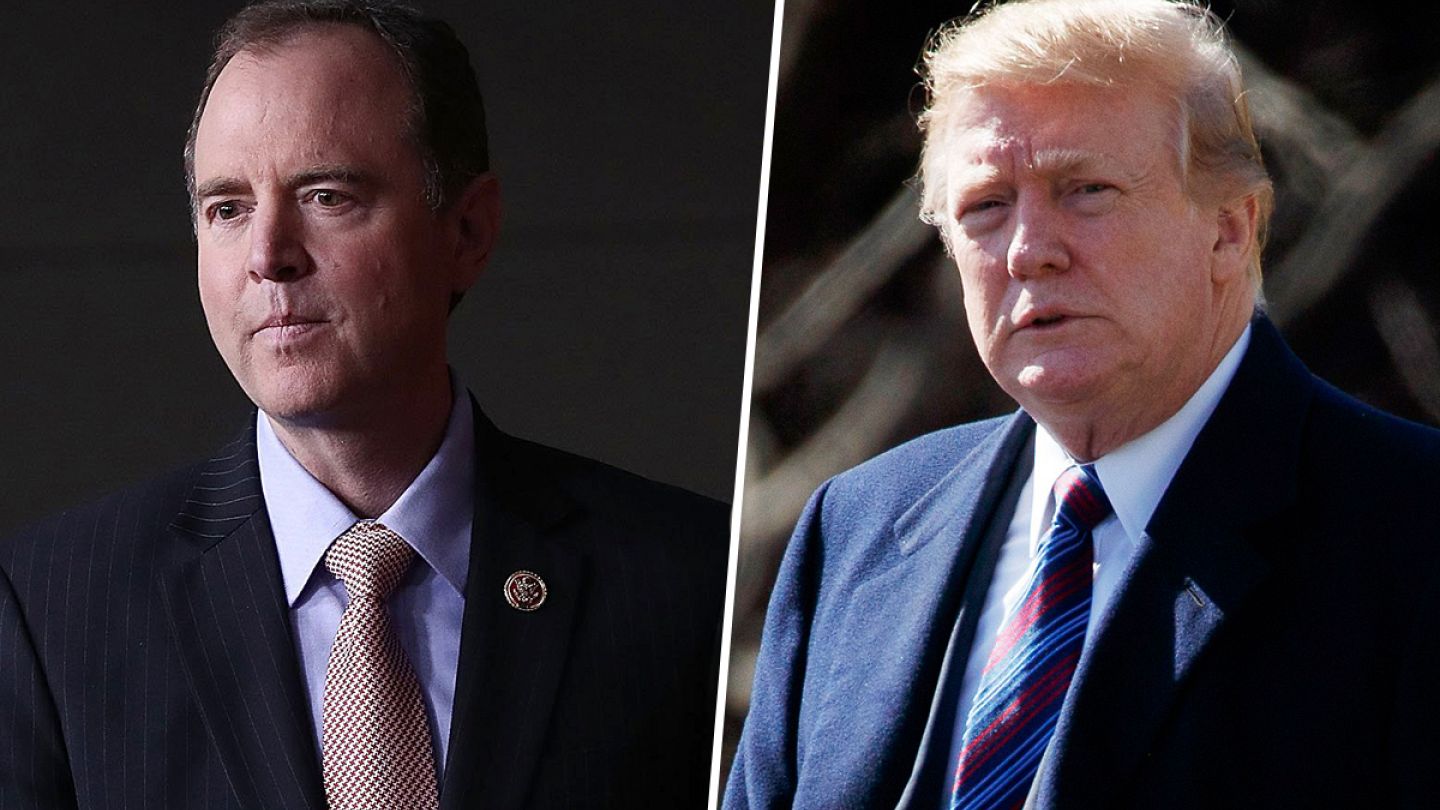
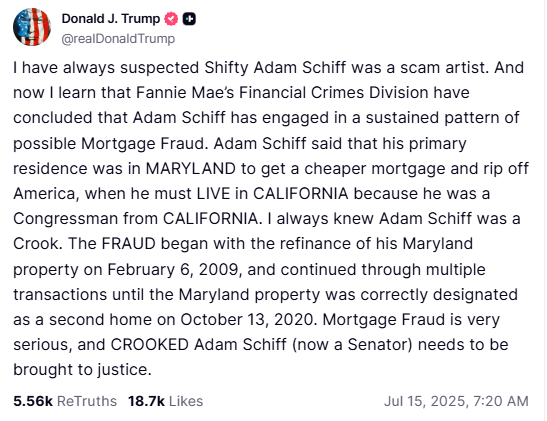
In an explosive social media post on Tuesday, President Trump leveled a direct accusation of criminal conduct against a sitting U.S. Senator and longtime political rival, Adam Schiff. Citing unverified claims, the President declared Schiff a “scam artist” who engaged in mortgage fraud and must be “brought to justice.”
This accusation comes at a moment when the administration is facing intense public pressure and internal turmoil over its handling of the newly released Jeffrey Epstein files.
As questions about that investigation continue to dominate headlines, this sudden, sharp focus on a political rival raises its own set of profound constitutional questions.
This is not merely about the specific allegations against a senator, or even about the timing of the news cycle. It is about the fundamental guardrails that separate a president’s political speech from the impartial administration of justice, and what it means when those two roles appear to merge.
The moment a president uses his platform to publicly act as prosecutor against a political enemy, it tests the very foundations of the rule of law.
A Question of Residency, A Question of Law
The accusation centers on Senator Schiff’s residency. The claim, first raised by a political opponent of Schiff’s, is that he fraudulently designated a home in Maryland as his “principal residence” on mortgage documents for over a decade to secure better loan terms, all while representing a district in California.
It is crucial to separate the legal requirements of a mortgage application from the constitutional requirements for holding office. Article I of the Constitution simply requires that a member of Congress be an “inhabitant” of the state they represent at the time of their election.
The framers understood that federal service would require significant time in the nation’s capital. While the specific claims of mortgage fraud are a matter for financial and legal experts to investigate, the constitutional residency requirement itself is not in question.
A Test of the “Take Care” Clause
The most serious constitutional issue raised by the President’s post is its challenge to the separation of powers. The President’s core duty under Article II is to “take Care that the Laws be faithfully executed.”
This has long been understood to mean overseeing a system of impartial justice, where decisions to investigate and prosecute are made by the Department of Justice and the FBI based on evidence, free from political pressure.
When a president publicly accuses a specific citizen of a crime and demands they be “brought to justice,” he shatters this principle. It creates immense political pressure on the Attorney General and federal investigators to pursue a case against a high-profile opponent of the President.
This blurs the sacred line between law enforcement and political retribution. The “faithful execution” of the laws requires that they be applied equally to all, not wielded as a weapon by the executive against those he perceives as enemies.
A Chilling Effect on a Co-Equal Branch
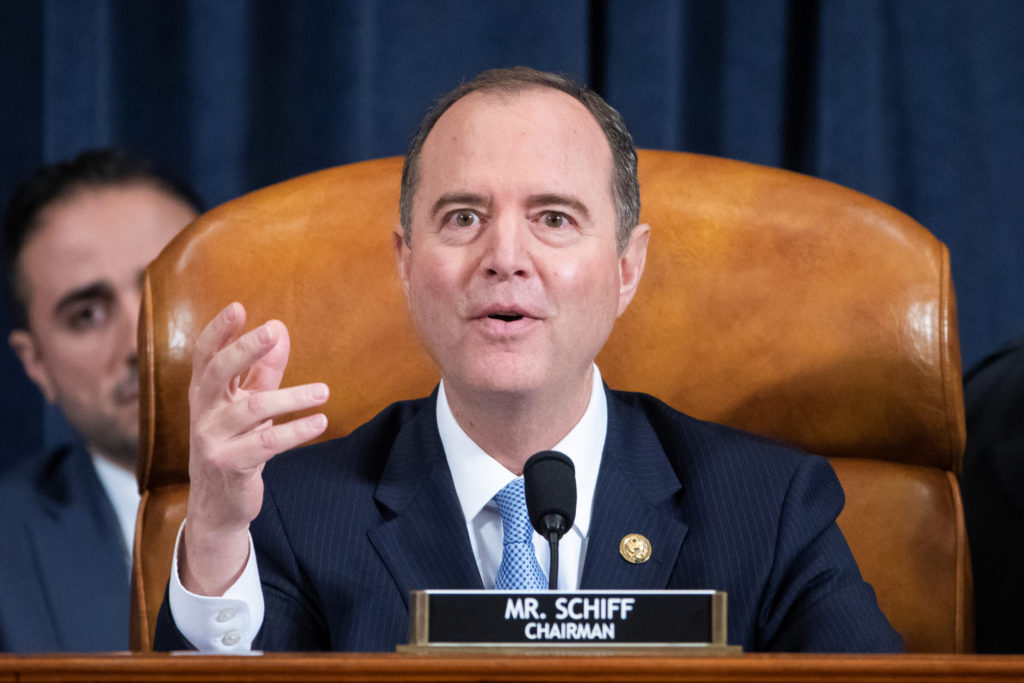
The context of this accusation cannot be ignored. Senator Schiff was the public face of two impeachment proceedings against President Trump and a key figure in numerous investigations into his administration. In his defense, Schiff labeled the President’s post a “baseless attempt at political retribution.”
This is where the threat to our constitutional order becomes most acute. Even if the investigation into the mortgage claims is handled impartially, the President’s act of publicly targeting a chief legislative antagonist creates a dangerous chilling effect.
It sends a powerful message to every member of Congress:
if you pursue your constitutional duty of oversight too vigorously, the President may use his immense public platform and the authority of his office to scrutinize your personal life and call for your prosecution.
This is a tactic that threatens the independence of Congress, a co-equal branch of government.
The specific allegations against Senator Schiff will ultimately be a matter for investigators to determine based on facts and evidence. But the method of the accusation is a separate and more profound issue. In our republic, accusations of federal crimes are meant to be investigated quietly and professionally. They are not meant to be proclaimed by a president on social media against his political rivals. This act risks turning the instruments of justice into weapons of political warfare, a danger the framers of the Constitution deeply feared and deliberately sought to prevent.