
In a late-night social media post, President Donald Trump issued a direct and unambiguous ultimatum to members of his own party: fall in line and defund public broadcasting, or forfeit his crucial endorsement.
The post, targeting the Corporation for Public Broadcasting (CPB), which provides funding for PBS and NPR, frames the issue as a matter of party loyalty ahead of a key vote on a spending bill.
But beneath the surface of this political threat lies a profound constitutional conflict. It raises alarms about the use of presidential power to influence media coverage and tests the legal firewall that was designed nearly 60 years ago to protect public broadcasting from precisely this kind of political pressure.
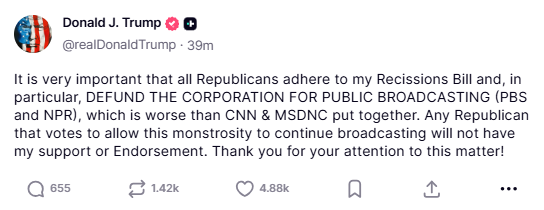
The President’s Demand
In his post on Truth Social, President Trump was explicit. He called on all Republicans to support his “Recissions Bill” and, specifically, to “DEFUND THE CORPORATION FOR PUBLIC BROADCASTING,” which he described as “worse than CNN & MSDNC put together.”
He concluded with a stark warning: “Any Republican that votes to allow this monstrosity to continue broadcasting will not have my support or Endorsement.”
This statement transforms a long-running policy debate into a personal loyalty test. It is a clear signal that the President views public media not as an independent entity, but as a political adversary that should be punished with the power of the federal purse.

The Firewall: Why Public Broadcasting Was Created
To understand the gravity of this threat, it’s essential to understand why the Corporation for Public Broadcasting was created in the first place.
Signed into law by President Lyndon B. Johnson in 1967, the Public Broadcasting Act was designed to foster non-commercial, educational television and radio. Crucially, the CPB was established as a private, non-profit corporation to serve as a heat shield or “firewall” between the media outlets and political influence from Congress and the White House.
The government provides an annual appropriation to the CPB, which then distributes those funds to more than 1,500 local PBS and NPR member stations across the country. These local stations, not a central office in Washington, make their own programming and editorial decisions. This structure was deliberately created to prevent the very thing critics now fear: taxpayer-funded media becoming state-run propaganda.
“The firewall was designed to prevent the very thing critics now fear: taxpayer-funded media becoming state-run propaganda.”
The Constitutional Tightrope
The President’s ultimatum walks a razor-thin constitutional line.
On one hand, Congress holds the “power of the purse.” It is well within its rights to decide which programs to fund and which to cut. The President, as the head of the executive branch and his party, has every right to advocate for his policy preferences.
However, the First Amendment’s protection of a free press creates a major complication. While the government is not obligated to fund the media, legal scholars argue that it cannot use the threat of defunding as a tool to punish or coerce news outlets into providing favorable coverage.
“When the threat to defund a news organization is explicitly tied to its content, it can be viewed as an attempt to use government power to silence a critical press – a form of executive overreach that raises serious First Amendment alarms.”
The President’s statement, directly linking his demand to defund with his opinion that PBS and NPR’s coverage is “worse than CNN,” makes it clear that the move is retaliatory, based on the content of their reporting.

The Grievances and the Media’s Job
The administration and its allies have long been critical of what they see as a persistent liberal bias in NPR and PBS’s news coverage.
They frequently point to reporting from programs like PBS’s “Frontline” or NPR’s “Morning Edition” that has been critical of the administration’s policies on immigration, the environment, and foreign relations. One notable example was NPR’s extensive coverage of the “weaponization working group” within the Justice Department, which the White House viewed as deeply unfair.
Journalists at these outlets, however, argue they are simply doing their job: holding power to account, regardless of which party is in the White House. They contend that their mission is to serve the public by providing in-depth, fact-based reporting that commercial news outlets often lack the resources to produce.
The Future of the People’s Airwaves
President Trump’s ultimatum forces a critical debate about the future of public media in a hyper-partisan America.
It is a direct challenge to the nearly 60-year-old consensus that non-commercial, educational broadcasting is a public good worthy of federal support, provided it remains free from government control. The President is now arguing that if that “public good” produces coverage he deems hostile, its taxpayer funding should be stripped away.
This conflict pits the power of a President to enforce party discipline against the First Amendment principles that protect the press from government intimidation. The outcome of this fight will determine whether public broadcasting’s firewall can withstand a direct assault, or if the “people’s airwaves” will become just another casualty of our nation’s political wars.