
For over fifty years, a single, 37-word sentence in American law has been one of the most powerful engines for equality in our nation’s history.
Title IX of the Education Amendments of 1972 is a cornerstone of civil rights, yet its simple language is now at the center of a fierce and profound constitutional battle.
The law, designed to prevent discrimination, is being used as both a sword and a shield in a legal fight that pits the rights of one protected group against another.
This new conflict, which has now reached the highest levels of our government, forces us to ask a fundamental question:
What does it mean to be protected “on the basis of sex” in the 21st century?
The answer will have consequences that ripple far beyond the classroom and the athletic field, redefining the future of civil rights law in America.
What is Title IX?: The Plain Language of the Law
To understand the current debate, we must first understand the law itself. Passed in 1972, Title IX is remarkably straightforward. Its core provision states:
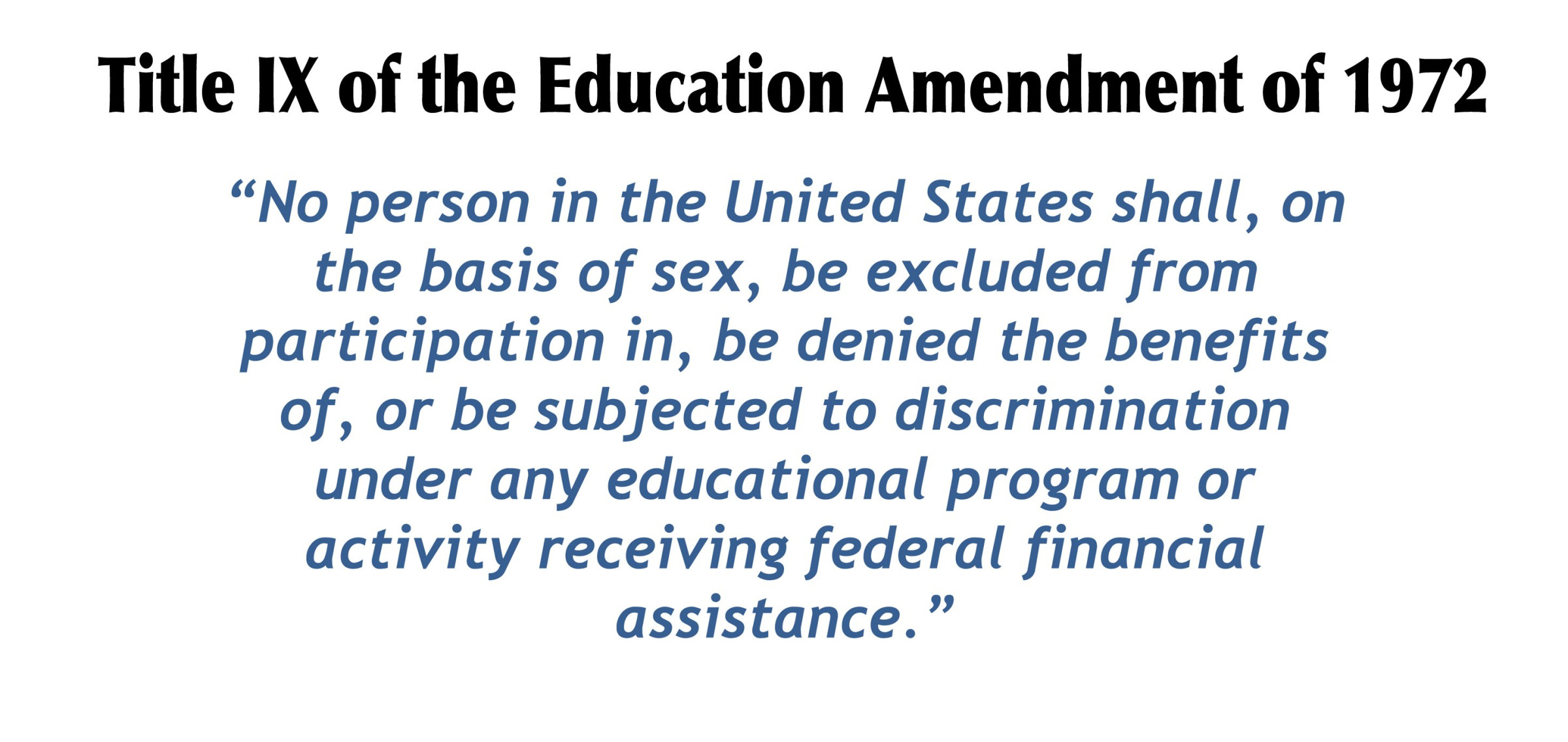
“No person in the United States shall, on the basis of sex, be excluded from participation in, be denied the benefits of, or be subjected to discrimination under any education program or activity receiving Federal financial assistance.”
The original intent was to remedy the pervasive and systemic discrimination against women in education. At the time, many universities had explicit quotas limiting the number of female students, and women were routinely denied equal access to academic programs and financial aid.
While its most famous legacy is the revolutionary expansion of women’s sports, the law’s text is broad, applying to every aspect of education at any institution that receives federal money.
A History of Enforcement: From Athletics to Harassment
Over the decades, the application of Title IX has evolved through enforcement and landmark court cases, broadening its protections.
- Athletics: Before Title IX, opportunities for female athletes were virtually nonexistent. The law forced schools and universities to provide equitable funding, facilities, and opportunities for women’s sports, leading to an explosion in participation that has transformed American athletics and society.
- Sexual Harassment: The law’s reach was significantly expanded by the Supreme Court. In cases like Franklin v. Gwinnett County Public Schools (1992), the Court ruled that sexual harassment and assault constitute a form of sex-based discrimination. This established that Title IX not only guarantees access to opportunities but also protects the right to an educational environment free from harassment.

These historical applications established Title IX as a powerful tool for ensuring that students can learn and compete in an environment free from discrimination based on their sex.
The Current Battleground: The DOJ Sues California
That foundational civil rights law is now at the center of a new and contentious legal fight. The U.S. Department of Justice, under the Trump administration, has filed a lawsuit against the state of California. The suit alleges that a California state policy allowing transgender students to compete on athletic teams consistent with their gender identity is, itself, a violation of Title IX.
This lawsuit creates a constitutional paradox, with two competing civil rights claims being made under the very same statute.
- The Department of Justice’s Argument: The DOJ contends that “on the basis of sex” refers to biological sex at birth. From this perspective, allowing transgender females (who are biologically male) to compete in women’s sports denies cisgender female athletes an equal opportunity to compete and win, thereby violating their Title IX rights.
- California’s Argument: The state argues that discriminating against a transgender athlete because of their gender identity is inherently a form of discrimination “on the basis of sex.” This view, supported by the reasoning in recent Supreme Court employment cases, holds that excluding transgender girls from girls’ sports is a violation of their Title IX rights.

This case is not just about a single state law or a high school track meet. It is a fundamental conflict over the legal and constitutional definition of “sex.” The courts are being asked to resolve a question that has deeply divided American society. The outcome will have profound implications, potentially setting a national precedent for the rights of transgender individuals and the future of women’s sports.
This is a powerful, modern example of how our enduring constitutional and legal principles are constantly tested by new and complex societal questions.