
How do you force a powerful, multi-billion dollar global industry to bend to your will? The President has just announced his answer: the threat of a massive, 100% tax on their imported products.
This new tariff on the pharmaceutical industry is not just another move in the administration’s trade wars. It is a high-stakes, constitutional game of chicken between the White House and Big Pharma. It is a profound test of presidential power and an attempt to use the authority of the executive to single-handedly reshape the future of American manufacturing.

A Tax with an “Off-Ramp”
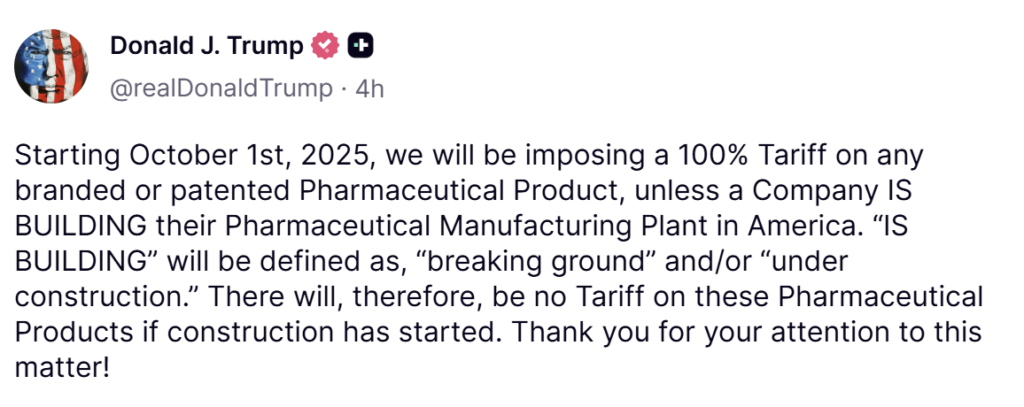
The President’s new policy, set to take effect on October 1, is a study in both brute force and clever design. He has announced a 100% tariff on all imported brand-name or patented pharmaceutical products.
However, he immediately provided a massive loophole, or “off-ramp.” The tariff will not apply to any drugmaker that is currently “breaking ground” or has a manufacturing plant “under construction” in the United States. This is a clear and direct message to the industry: build your factories here, or pay the price.
The Constitutional Power to Compel
This is where the story becomes a crucial constitutional lesson. The power to set tariffs and regulate foreign commerce belongs, under Article I of the Constitution, to Congress. Over the decades, however, Congress has delegated vast portions of that authority to the President to allow for more flexibility in a fast-moving global economy.

The President is now using that delegated power in a novel and aggressive way. He is not just setting a tax rate; he is creating a complex system of incentives and punishments. He is using the threat of a tax as a tool of industrial policy to compel a specific corporate behavior – domestic investment – that he believes is in the national interest.
A Battle of Competing Goods
The administration’s move has ignited a fierce debate over two legitimate, but competing, public goods.
The White House argues that this policy is essential for national security. By forcing drugmakers to build plants in the U.S., it aims to create a secure domestic supply chain for essential medicines and end our reliance on foreign nations like China.

The pharmaceutical industry, however, warns of a devastating trade-off. They argue that “every dollar spent on tariffs is a dollar that cannot be invested in American manufacturing or the development of future treatments and cures.” They contend that this policy will stifle the very innovation that leads to the next generation of life-saving medicines.
The President’s new pharmaceutical tariff is a masterful piece of political pressure that may, due to its built-in loopholes, have very little real-world economic impact. Its true significance is constitutional. It sets a new and powerful precedent for how a president can use the threat of delegated trade authority as a cudgel to force an entire industry to align with his political and economic goals. It is another major step in the long, slow transfer of power over the American economy from the halls of Congress to the Oval Office.