
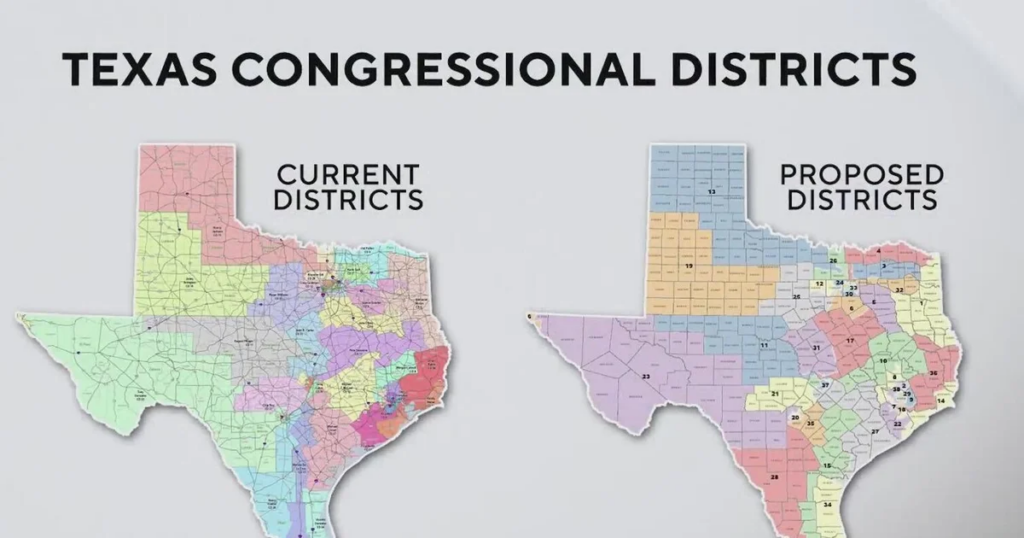
A new Republican-drawn political map in Texas creates several new Hispanic-majority congressional districts. To its supporters, it’s a long-overdue victory for minority representation. To its opponents, it’s an illegal and cynical tactic designed to disenfranchise those very same voters.
This is the confounding and constitutionally complex debate at the heart of the Texas redistricting war.
The fight is no longer about whether to create minority districts, but about who those districts are truly designed to empower. It is a battle that will test the very limits of the Voting Rights Act in a new era of American politics.

The Texas Hispanic Vote Debate
- What’s Happening: The new Republican-drawn congressional map in Texas is being praised by some Republicans and condemned by Democrats for its impact on Hispanic voters.
- The Republican View (Mayra Flores): The map increases Hispanic representation by creating four new Hispanic-majority districts that reflect the growing number of conservative Hispanic voters in the state.
- The Democratic View: The map illegally dilutes Hispanic voting power by “packing” and “cracking” communities to ensure those new districts elect Republicans, not the candidates the majority of Hispanic voters in those areas would choose.
- The Constitutional Issue: A major test of the Voting Rights Act of 1965. Does the law protect a minority group’s right to elect any candidate of their choice, or its ability to elect candidates from its historically preferred political party?
‘A Representation of What Texas is Today’
The most powerful defense of the new Republican map is coming from a new generation of conservative Hispanic leaders like former Congresswoman Mayra Flores.
Flores, who was born in Mexico and represented a Texas border district, argues that the map is a reflection of a dramatic political realignment.
“They’re upset because these Hispanics – they’re conservative Hispanics – have voted for President Trump. This map actually is more of a representation of what Texas is today.” – Former Rep. Mayra Flores
She points to the fact that President Trump won a dozen Texas border counties in 2024 and that four of the five new GOP-friendly districts are, in fact, majority-Hispanic. The argument is simple: the map empowers Hispanic communities by giving them more districts where they are the majority, and if those communities choose to elect conservative Republicans, that is their democratic right.

‘Diluting’ the Vote: The Democratic Counter-Argument
Democrats and civil rights groups see a much more sinister design at play.
They argue that the map is a classic gerrymander that uses the techniques of “packing” and “cracking” to illegally dilute the collective power of minority voters.
An editorial from the San Antonio Express-News claims Republicans are “packing” minority voters into a few districts where they already have a super-majority, while “dispersing” them into multiple other districts where they will be outnumbered by conservative white voters.
“The Don demanded. The Texas Legislature complied. Voters got hurt.” – San Antonio Express-News editorial
They contend that while the new districts may be “Hispanic-majority” on paper, they have been surgically drawn to ensure that a Republican wins, effectively silencing the majority of Hispanic voters who still, as a bloc, tend to vote for Democrats.
The Voting Rights Act
This entire dispute will now be fought in federal court, and it will hinge on the interpretation of the landmark Voting Rights Act of 1965 (VRA).
Section 2 of the VRA is the nation’s most powerful tool against racial discrimination in voting. It prohibits any voting practice or procedure that results in the “denial or abridgement of the right of any citizen… to vote on account of race or color.”
For decades, courts have used a test established in the 1986 Supreme Court case Thornburg v. Gingles to determine if a map illegally “dilutes” the votes of a minority group. A key part of that test requires showing that the minority group is “politically cohesive.”
This is where the Texas case becomes a profound and historic test of the VRA.
“This is a profound and historic test of the Voting Rights Act. The law was designed to prevent a white majority from overwhelming a politically unified minority. But what happens when that minority group itself is no longer politically unified?”
Republicans will argue that the rise of conservative Hispanics proves the community is no longer “politically cohesive,” and therefore the old rules don’t apply. Democrats will argue that the vast majority of Hispanic voters still form a cohesive bloc that is being intentionally fractured by the new map.
A New Chapter in Representation
The fight over the Texas map marks a new and complex chapter in the long and often painful story of voting rights in America. It moves the debate beyond simple questions of creating majority-minority districts.
The coming court battles will force the judiciary to grapple with the changing political identity of the nation’s largest minority group. The outcome will determine what the Voting Rights Act means in an era where the lines of race and politics are becoming increasingly, and complicatedly, blurred.