
A legal case can pivot in an instant – on a single piece of evidence so damning it recasts everything that came before it. In the investigation of Tyler Robinson, that moment appears to have arrived not in a sterile interrogation room, but in the casual, unguarded space of a text message exchange.
The emergence of these messages transforms the case from a question of public confrontation to a chilling study in premeditation, motive, and the modern criminal’s fatal flaw – the digital footprint.
What Do the Messages Actually Say?
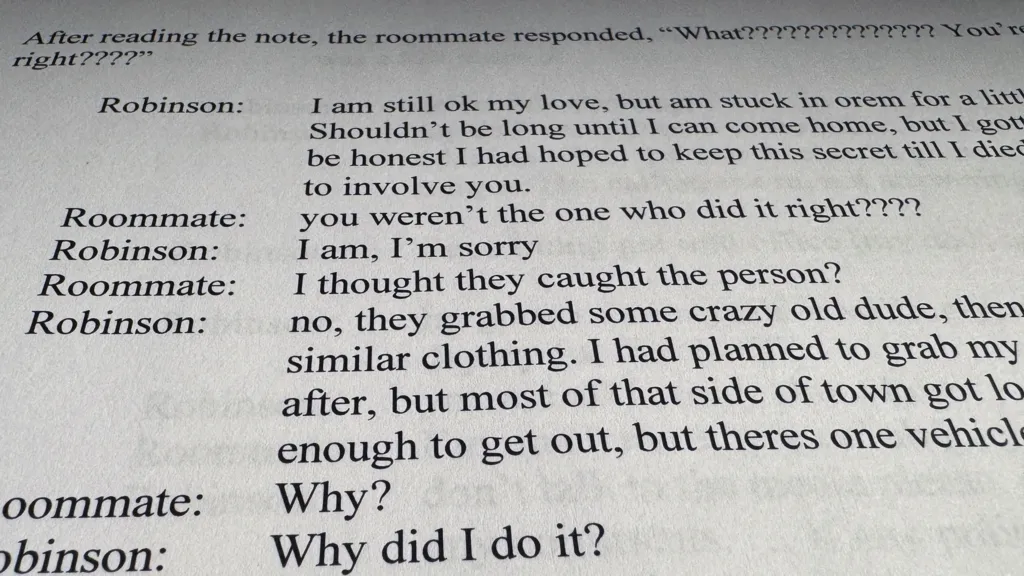
The newly surfaced texts, allegedly from Robinson, paint a portrait of a man not caught in a spontaneous act, but one who had been planning for more than a week. The conversation reveals a clear and deeply personal motive: “had enough of his hatred. Some hate can’t be negotiated out.”
This statement provides prosecutors with a powerful narrative of ideologically driven violence. The messages go on to detail a “drop point” for a rifle, a last-minute change of plans due to a police presence, and the subsequent hiding of the unique weapon – a “grandpas rifle” with a “very unique” engraving – in a bush.
Can a Single Text Demolish Constitutional Protections?
The defense’s primary strategy will now shift. Their most viable – perhaps only – path forward is to challenge the legality of how these messages were obtained.
This invokes the Fourth Amendment and its protection against unreasonable searches, leading to the “fruit of the poisonous tree” doctrine.
This legal principle holds that evidence obtained illegally is inadmissible in court. The defense will file motions to suppress the texts, arguing that law enforcement violated Robinson’s constitutional rights in acquiring them. The entire case could hinge on the validity of a single search warrant.
“delete this exchange”
According to a charging document in the case, the roommate provided those messages to police.

Are Three Words a Confession of Guilt?
Perhaps the most catastrophic element for the defense is Robinson’s alleged instruction to the recipient: “delete this exchange.” Legally, this is devastating. It demonstrates a clear “consciousness of guilt” and could be interpreted as an attempt to obstruct justice or destroy evidence – a serious crime in itself.
A prosecutor will argue that this is not the action of an innocent man. It is a calculated attempt to erase a confession, and it will be presented to a jury as proof of a guilty mind.
Has History Seen This Before?
While the technology is new, the scenario is not. For centuries, legal cases have turned on intercepted letters and private diaries. In the infamous 1924 Leopold and Loeb murder case, Nathan Leopold’s detailed pre-crime “notes” and arrogant correspondence became key evidence that unraveled his claims of innocence and exposed the chilling premeditation of their crime. The medium changes – from ink to pixels – but the incriminating nature of a written plan remains the same.
Is There Any Room Left for Doubt?
The impact of this evidence on a potential jury cannot be overstated. Text messages feel intimate and unfiltered – a direct window into the sender’s mind. While the law demands that a jury presume innocence and weigh all evidence dispassionately, a digital confession, complete with a motive and an order to hide the proof, is profoundly persuasive.
This is the central challenge for our system of justice. The state’s evidence may seem overwhelming, but the constitutional process must be honored. The Robinson case has now become a defining test – not just of one man’s guilt, but of whether our legal safeguards can withstand the seemingly absolute certainty of a digital confession.