
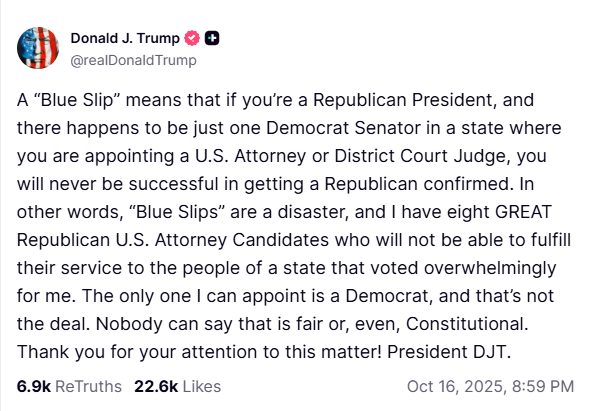
Trump appointed U.S. attorneys in blue states without Senate confirmation, using legal workarounds to bypass the “blue slip” tradition requiring home-state senators’ approval. Now the prosecutions these attorneys brought – against James Comey, New York Attorney General Letitia James, and others – face dismissal because courts are questioning whether the prosecutors had legal authority to bring charges.
The constitutional problem is straightforward: Article II requires Senate confirmation for significant federal appointments. Congress established vacancy laws allowing temporary appointments during transitions, but those laws weren’t designed to function as permanent end-runs around Senate confirmation. Trump and Attorney General Pam Bondi have used those laws repeatedly to keep Trump loyalists in power despite Senate opposition.
The consequences are severe. High-profile indictments could be thrown out. Criminal cases could collapse. And the judiciary is beginning to signal that Trump’s appointment strategy violates both statutory safeguards and constitutional structure designed to prevent executive power concentration.
Discussion
Typical fake news trying to undermine Trump again! The man bypassed the corrupt system because Democrats would block his choices no matter what. They're scared of prosecutors looking into THEM for once. The Senate's tradition isn't always LAWS. Trump played by the rules that exist, but the Dems always cry foul when they don’t get their way. These court cases are more partisan attacks to discredit those who dared to hold the left accountable! Enough with this political witch hunt against real change-makers. Trump was shaking the establishment, and the swamp couldn't handle it! MAGA!
Cliff is a fool and should not be listened to.
magats be damned!
Oh please, it's not a witch hunt, it's about upholding the Constitution, something Trump and his fan club conveniently ignore. Bypassing the Senate isn't playing by the rules, it's abusing the system. Get real.
When you can't get who you want in, I would think anything goes. No other president has had this much restraint put on his choices to fill his department!
But democrats can do whatever they want , right?
This is why we need to unite against this Blue Wing and only get RED WINGS IN FOR THE SAFETY OF THE USA!
The democrats are just like little kids. Cry when they don't get their own way. They can't take it but they sure try to dish it out.
Whole Judiciary System
Corrupt
By Pass Necessary
Brick Wall Proves It
Leave a Comment
Leave a Comment
The Comey Case That Exposes the Problem
Trump directed the removal of U.S. Attorney Erik Siebert in Virginia specifically because Siebert opposed bringing charges against Comey and New York Attorney General Letitia James – both Trump political nemeses. Within days, Trump installed Lindsey Halligan, a former insurance lawyer with no prosecutorial experience, to replace him.
Halligan brought the Comey indictment. She was the sole prosecutor to sign the charging document. Now Comey’s attorneys are contesting her authority to prosecute, arguing her unconventional appointment means she lacks legal standing to bring charges.
The distinction matters constitutionally. If Halligan didn’t have proper appointment authority, she couldn’t exercise prosecutorial power. Any actions she took in official capacity would be void. The indictment she signed – the only indictment she signed – would be void. The prosecution collapses.
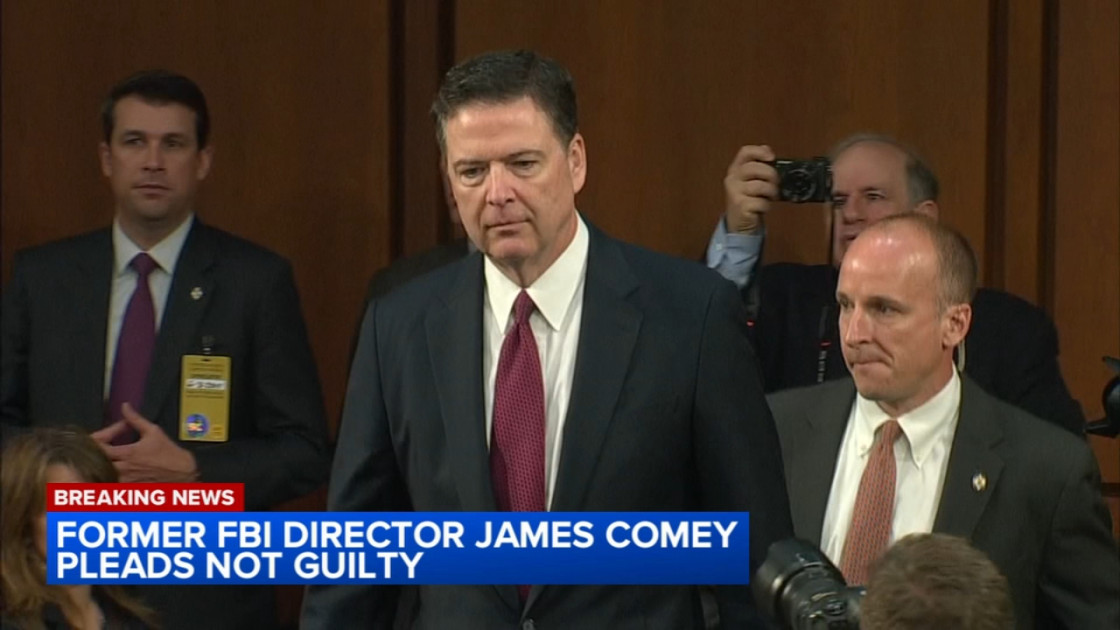
Law professor Josh Blackman told Fox News: “If it’s found that she was not properly appointed – she was the only person who signed the Comey indictment – that indictment’s thrown out, so the stakes are actually pretty high.”
The judge could avoid the appointment question by dismissing the case on other grounds. But that avoidance doesn’t resolve the underlying constitutional problem – it just postpones it.
A Pattern Across Multiple Districts?
Halligan isn’t alone. U.S. Attorney Alina Habba in New Jersey faces similar challenges after Trump used vacancy law workarounds to re-install her despite Democratic senators Cory Booker and Andy Kim refusing to support her confirmation.
Judge Matthew Brann found Habba’s appointment unlawful. The 3rd Circuit Court of Appeals will hear arguments Monday in a case potentially headed to the Supreme Court. The DOJ is defending the appointment by arguing “it is utterly implausible that Congress intended the default to be that the President must rely on career officials who may disagree with his policies.”
But that argument misses the constitutional point. The question isn’t whether Congress intended to make presidents rely on disagreeing officials. It’s whether the President can simply ignore Senate confirmation requirements through statutory workarounds.
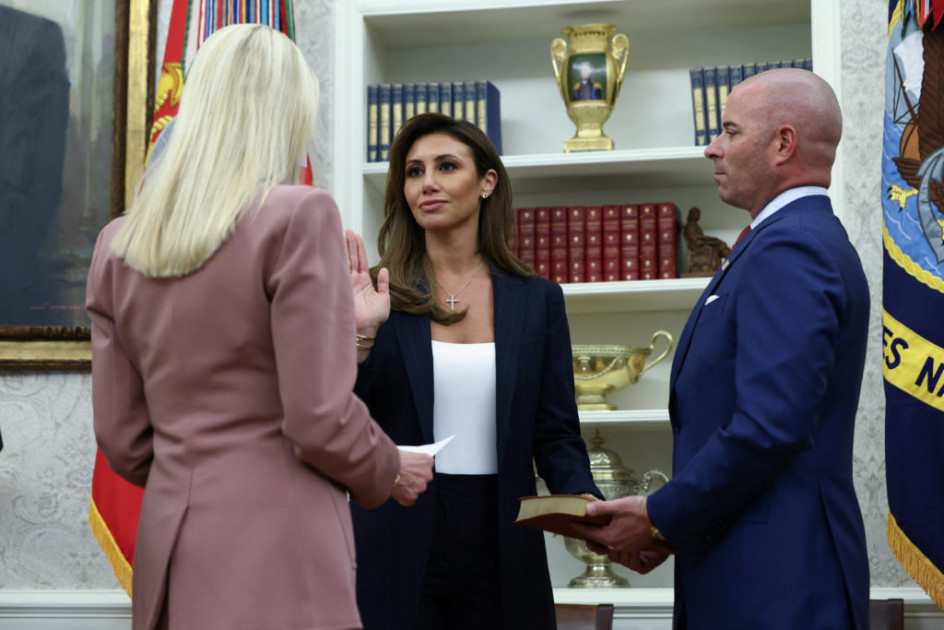
Similar challenges face U.S. Attorney Bill Essayli in California, where defendants in immigration cases are seeking to have charges dismissed on grounds that Essayli is an invalid appointee. Judge Sigal Chattah was disqualified from serving as temporary U.S. attorney in Nevada entirely after court challenges.
The pattern reveals Trump administration strategy: identify prosecutors loyal to Trump, use vacancy law provisions to keep them in place, and protect them from Senate confirmation requirements by cycling through successive “acting” appointments.
The Vacancy Laws That Weren’t Designed for This
Federal vacancy law allows the president to appoint temporary acting officials during transitions while Senate confirmation proceeds. The law assumes temporary appointments – typically 120 to 210 days – provide runway for Senate process rather than permanent substitutes for confirmation.
Trump and Bondi have used successive reappointments and statutory workarounds to keep the same people in office indefinitely without ever submitting them for confirmation. When one temporary appointment expires, they fire the court-appointed successor and re-install their preferred person as “acting” attorney again.
This technically complies with statutory language while violating the statutory scheme’s apparent purpose. The vacancy laws were designed to manage transitions, not to allow presidents to permanently circumvent Senate confirmation.
That distinction matters legally. Courts are now examining whether the statutory scheme permits what Trump is doing or whether the approach violates the spirit of the law even if technically compliant with its language.
The Constitutional Question Courts Are Asking
The Appointments Clause of Article II states that the President “shall nominate, and by and with the Advice and Consent of the Senate, shall appoint” officers of the United States. U.S. attorneys qualify as officers requiring Senate confirmation.
Congress can establish lower categories of officials – “inferior officers” – who can be appointed by the President alone, Cabinet secretaries, or courts. But U.S. attorneys, who exercise significant prosecutorial discretion and represent the government in federal court, are principal officers requiring Senate confirmation.
The vacancy laws allow for temporary appointments of principal officers during transitions. But they contemutively function as workarounds to bypass Senate confirmation permanently, does that violate Article II’s requirement even if statutory language technically permits it?
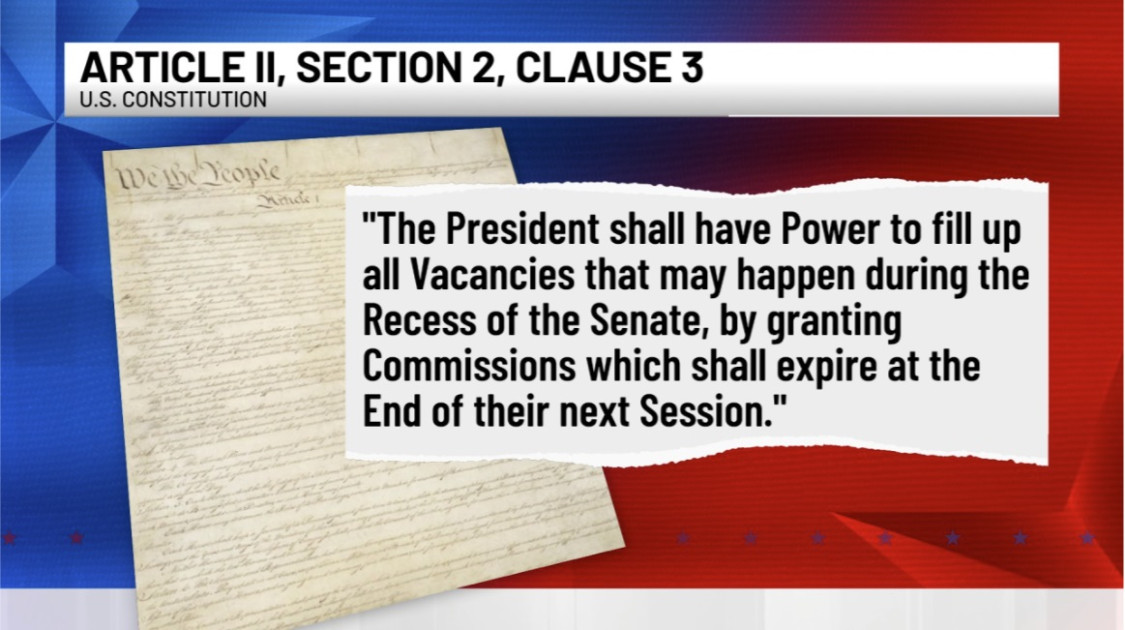
Courts are beginning to say yes. Judge Brann’s finding that Habba’s appointment was unlawful suggests the judiciary is reading the vacancy laws as temporary measures, not permanent replacements for Senate confirmation.
Why This Mattered to Trump
Trump selected these prosecutors specifically because they would bring prosecutions he wanted – against Comey, James, and others he views as political enemies. Senate Democrats would never confirm prosecutors selected primarily for willingness to prosecute the president’s political opposition.
That inability to confirm forced Trump to choose: either accept prosecutors Senate-confirmed Democrats could approve, or use appointment workarounds to keep Trump loyalists in place. Trump chose the latter strategy.
The approach reveals something troubling about executive power: If a president can use statutory workarounds to permanently circumvent Senate confirmation, Senate oversight of executive appointments becomes theoretical rather than real. The Senate loses its constitutional check on appointments.
That loss matters because Senate confirmation forces presidents to at least consider how nominees will be perceived. Politically extreme nominees face rejection. Prosecutors selected solely for partisan loyalty face scrutiny. The confirmation process creates pressure for institutional legitimacy even when presidents dislike Senate involvement.
Without that pressure, presidents can simply install loyalists through vacancy law cycling.
The DOJ’s Constitutional Argument
DOJ lawyers defend the appointments by arguing Congress and the Constitution favor executive power during transitions. They contend it’s “utterly implausible” Congress intended presidents to “rely on career officials who may disagree with his policies to serve as acting political officers during the critical period at the start of an administration.”
The argument contains logical force. Presidents do need loyal subordinates. Political appointees are supposed to advance presidential policy. Career officials who oppose the administration’s priorities can undermine implementation.
But that argument proves too much. If the president can simply install loyalists through vacancy workarounds whenever Senate confirmation seems unlikely, Senate oversight disappears entirely. The Appointments Clause becomes advisory rather than mandatory.
The Constitution distributes appointments power specifically to prevent that outcome. The Senate’s confirmation role exists to ensure that significant power-holders have at least some political accountability beyond pure presidential loyalty.
The Academic Disagreement
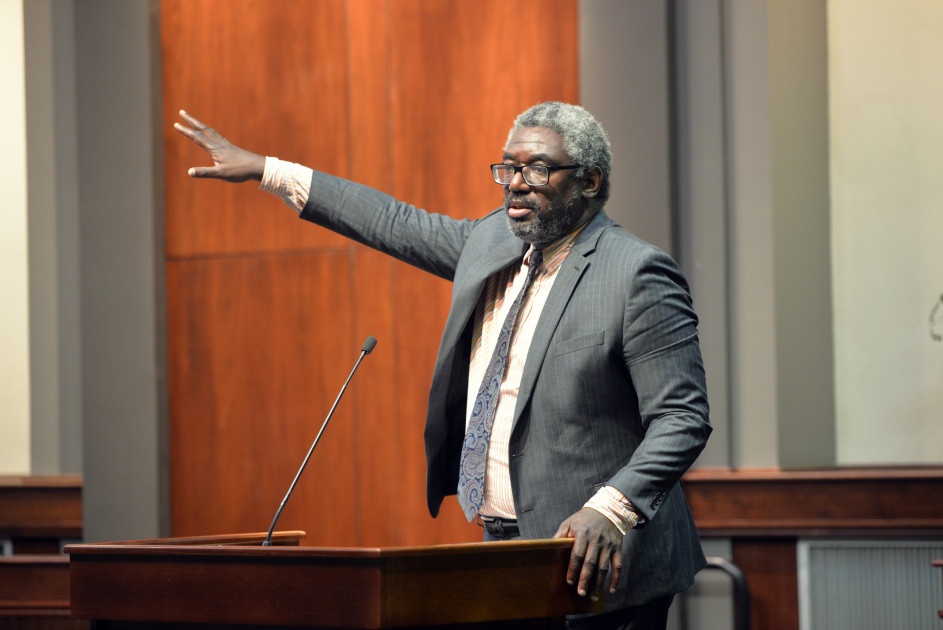
Law professors are split on whether Trump’s strategy violates the vacancy law scheme or operates within its bounds. Josh Blackman told Fox News that Trump is “pushing novel grounds” that haven’t been tested before in this manner.
Carl Tobias at University of Richmond law school said the escalation “defies the spirit of the Constitution” even if technically permissible under statute language. He emphasized the importance of “scrutiny from the Judiciary Committee and then on the Senate floor” in ensuring appointees meet some baseline institutional legitimacy standard.
But other legal scholars argue presidents need flexibility in staffing during administration transitions and that overly restrictive readings of vacancy laws handicap executive function.
The disagreement reveals genuine constitutional tension: How much Senate involvement in appointments is necessary to maintain constitutional structure? How much presidential autonomy is necessary for effective governance?
What the Courts Are Actually Deciding
When judges dismiss Comey’s indictment on grounds that Halligan lacked appointment authority, they’re deciding that vacancy laws don’t permit permanent circumvention of Senate confirmation. That decision establishes that presidents can’t simply use statutory workarounds as substitutes for Article II’s requirement.
If the Supreme Court eventually reviews these cases, it will need to determine whether the vacancy laws themselves are constitutional as applied to Trump’s strategy, or whether Congress needs to clarify the laws to prevent indefinite temporary appointments.
The stakes are high because the decisions will establish whether Senate confirmation remains meaningful check on presidential appointments or becomes optional obstacle that presidents can routinely bypass.
The Prosecutions That Hang in Balance
Beyond constitutional principle, the immediate consequence is that Trump’s prosecutions of political enemies may collapse. Comey’s case could be dismissed. James’ bank fraud indictment could be voided. Other cases brought by prosecutors appointed through these workarounds face similar vulnerability.
That outcome may seem like vindication to Trump allies who view these prosecutions as politically motivated. But it establishes dangerous precedent: appointments made to circumvent Senate confirmation produce legally invalid prosecutions.
That pattern could apply to any significant executive action taken by an official whose appointment courts determine was invalid. Entire policy initiatives could be voided retroactively if the official implementing them lacked proper appointment authority.
What the Comey Prosecution Reveals
The Comey case demonstrates why Senate confirmation matters. Trump wanted Comey prosecuted. A prosecutor with independent confirmation through Senate review would presumably apply uniform charging standards regardless of political relationship to the president. A prosecutor selected solely for willingness to pursue Trump’s preferred targets faces no such institutional constraint.
Halligan was installed specifically to bring cases Trump wanted. She brought them. Now courts are questioning whether she had authority to do so – not because she lacked prosecutorial skill but because her appointment violated the Article II process.
The trial of whether prosecutors were properly appointed becomes entangled with the trial of whether their prosecutions were proper. The institutional safeguards designed to prevent purely political prosecutions get tested when those prosecutions occur through institutionally improper appointment mechanisms.
Why This Matters Beyond These Specific Cases
If courts permit Trump to use vacancy law workarounds to permanently circumvent Senate confirmation, future presidents will adopt the same strategy. The Appointments Clause becomes dead letter. Senate confirmation becomes advisory. Presidents simply install loyalists through statutory cycling and avoid Senate involvement entirely.
Conversely, if courts strike down these appointments and invalidate consequent prosecutions, Trump’s ability to staff his administration with trusted allies gets constrained. But constitutional structure gets preserved.
The Supreme Court will ultimately decide whether Article II’s confirmation requirement or statutory vacancy law workarounds prevail. That decision will establish whether Senate confirmation remains meaningful constitutional check or becomes optional formality presidents can routinely bypass.
This is a hard pill to swallow: If the prosecutors were appointed unconstitutionally, then every case they brought is illegitimate and must be thrown out, no matter who the defendant is. Change my mind.