
In a pair of remarkable social media posts over the weekend, the President of the United States publicly aired his frustration with his own Attorney General, demanding she move faster to prosecute his political enemies.
This public pressure campaign, targeting specific individuals by name, is more than just a glimpse into the President’s thinking.
It is a direct and open challenge to one of the most sacred, if unwritten, rules of our constitutional system: the independence of the Department of Justice from partisan political influence.
At a Glance: The Presidential Pressure Campaign
- What’s Happening: President Trump has publicly called out his own Attorney General, Pam Bondi, demanding faster action in prosecuting his political adversaries.
- The Targets: He specifically named former FBI Director James Comey, Senator Adam Schiff, and NY AG Letitia James.
- The Quote: In a social media post directly addressing Bondi, Trump relayed his supporters’ frustrations and declared, “We can’t delay any longer, it’s killing our reputation and credibility.”
- The Constitutional Issue: A major test of the long-standing, post-Watergate norm of prosecutorial independence, which holds that the Justice Department should make charging decisions free from direct political pressure from the White House.
‘All Talk, No Action’
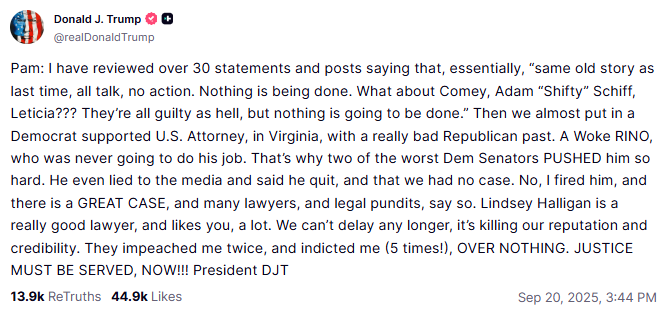
The first of President Trump’s Saturday posts was a direct address to his Attorney General, quoting what he said were the frustrations of his supporters.
“Pam: I have reviewed over 30 statements and posts saying that, essentially, ‘same old story as last time, all talk, no action. Nothing is being done. What about Comey, Adam ‘Shifty’ Schiff, Leticia??? They’re all guilty as hell, but nothing is going to be done.’” – President Donald Trump
He concluded the message by telling Bondi, “We can’t delay any longer.”
The post came just a day after Erik Siebert, the U.S. Attorney for the Eastern District of Virginia, resigned under intense pressure. Prosecutors in his office had reportedly concluded they did not have enough evidence to bring a mortgage fraud case against one of Trump’s targets, New York Attorney General Letitia James.
The Constitutional Firewall: Prosecutorial Independence
The President’s public demand is a direct assault on a 50-year-old constitutional norm that was forged in the fire of the Watergate scandal.
In the wake of the “Saturday Night Massacre,” where President Nixon ordered the firing of the special prosecutor investigating him, a strong tradition was established to create a wall of separation between the political desires of the White House and the day-to-day investigative and charging decisions of the Justice Department.

This norm is rooted in the President’s Article II duty to “take Care that the Laws be faithfully executed.” The post-Watergate interpretation of this clause is that “faithfully” means impartially, without using the awesome power of federal prosecution to punish a President’s personal enemies.
“This is a direct assault on a 50-year-old constitutional norm. The tradition of prosecutorial independence was built to prevent the very thing the President is now demanding in public: the use of the Justice Department to pursue a President’s political enemies.”
A Pivot and a New Appointment
Just over an hour after his first post, President Trump posted again. This time, he voiced support for Bondi, calling her “GREAT” and “very careful,” and pivoted the blame for the lack of action squarely onto the U.S. Attorney’s office that had just seen its leader resign.
He then announced his intention to use his Appointments Clause power to fix the problem, stating he wanted his own lawyer, Lindsey Halligan, appointed to the post to “get things moving.”

This sequence of events – publicly demanding a prosecutorial outcome and then seeking to install a personal lawyer in the very office responsible for that prosecution – is what critics are calling a blatant attempt to politicize the justice system.
The Blurring of the Lines
In brief comments to reporters Saturday evening, the President was unapologetic about his demands.
“I just want people to act. And we want to act fast,” he said, adding that when Democrats were in power, “they were ruthless and vicious.”
The President’s statements are a deliberate effort to erase the line between politics and prosecution. He is making it clear that he views the Justice Department not as a neutral arbiter of the law, but as an instrument of his executive will, and that he expects it to deliver results against his political foes.
This is a profound challenge to the post-Watergate consensus on the proper role of the DOJ. The coming weeks will reveal whether the department maintains its traditional independence, or bends to the will of a President demanding action – and demanding it now.