
In one capital, the White House, an American President is welcoming a key European ally, praising their “stronger than ever” relationship. Half a world away, in another capital, Beijing, the leaders of China, Russia, and North Korea are standing shoulder-to-shoulder, observing a massive military parade.
This stark, simultaneous display of competing alliances has put the world on edge.
The events of Wednesday thrust President Trump’s constitutional role as chief diplomat and commander-in-chief into the sharpest possible focus, showcasing the immense pressures of leading the free world in an age of rising authoritarianism.
A World Divided
- What’s Happening: President Trump is meeting with Poland’s new populist president, Karol Nawrocki, at the White House.
- The Geopolitical Context: The meeting is happening as China hosts a massive military parade attended by Russia’s Vladimir Putin and North Korea’s Kim Jong Un.
- The Message: Trump reaffirmed the U.S. troop presence in Poland as a signal to Russia, while simultaneously acknowledging he was watching the “impressive” parade of adversaries he says are “conspiring against” the U.S.
- The Constitutional Issue: A powerful display of the President’s Article II powers as Chief Diplomat (meeting an ally) and Commander-in-Chief (deploying troops and assessing foreign threats), all within the framework of a formal NATO treaty alliance.
A ‘Populist Firebrand’ in the Oval Office
President Trump on Wednesday rolled out the red carpet for Karol Nawrocki, the newly elected populist president of Poland. Nawrocki, a conservative firebrand endorsed by Trump earlier this year, praised the state of U.S.-Polish relations.
The most significant outcome of the meeting was President Trump’s public affirmation that the roughly 10,000 U.S. soldiers currently stationed in Poland will remain.
“This is the first time in Polish history… that the Poles are happy that we have foreign soldiers in Poland,” Nawrocki said in the Oval Office. “This is the signal to the whole world, and also to the Russian Federation, that we are together.”
An Alliance Reaffirmed, A Treaty Fulfilled
The presence of U.S. troops on Polish soil is not a casual deployment; it is a direct fulfillment of the nation’s obligations under the North Atlantic Treaty.
This treaty, ratified by the U.S. Senate in 1949, is the most sacred and legally binding commitment in U.S. foreign policy. It establishes the principle of collective defense, and the President’s decision to maintain troops in a frontline state like Poland is a direct exercise of his Article II power as Commander-in-Chief to execute the terms of that treaty.
“The presence of 10,000 American soldiers on Polish soil is a powerful exercise of the President’s power as Commander-in-Chief, fulfilling a treaty obligation ratified by the Senate decades ago.”
The Axis in the East: A Parade of Power
While the President was reassuring a nervous ally in Washington, a very different kind of meeting was taking place in Beijing.
In a massive show of force, Chinese President Xi Jinping oversaw a military parade to commemorate the 80th anniversary of the end of World War II. Standing beside him on the viewing platform were Russia’s Vladimir Putin and North Korea’s Kim Jong Un.
President Trump made it clear he was paying close attention.
“I understood the reason they were doing it, and they were hoping I was watching – and I was watching. My relationship with all of them is very good. We’re going to find out how good it is over the next week or two.” – President Donald Trump
In a social media post, the President accused the trio of “conspiring against” the United States, even as he described their military display as a “beautiful ceremony” and “very impressive.”
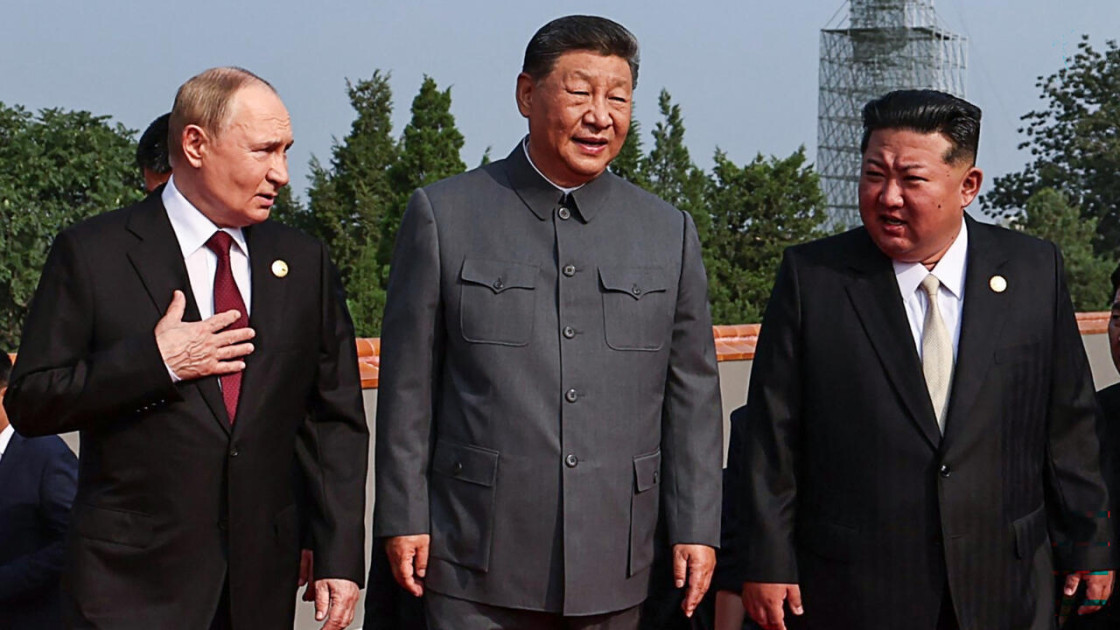
One President, Two Fronts
The day’s events are a perfect snapshot of the complex and dangerous world the President must navigate using his constitutional powers.
In the Oval Office, he played the role of the steadfast ally, reaffirming a treaty commitment to a key European partner on the front lines of Russian aggression.
At the same time, he was forced to watch and react to a powerful and coordinated display of military might from a new and growing axis of American adversaries in the East.
This is the tightrope of modern American foreign policy – reassuring allies and confronting enemies, often on the very same day.