
In a decision with massive implications for the American economy and the power of the presidency, a federal appeals court has declared that President Trump’s signature tariff policy is illegal.
The ruling strikes at the very heart of the President’s “America First” agenda and sets the stage for a monumental showdown at the Supreme Court.
This is more than a dispute over trade policy. It is a fundamental constitutional conflict over the limits of a President’s power and who truly holds the authority to tax and regulate commerce in the United States.
At a Glance: The Tariff Ruling
- What’s Happening: A powerful federal appeals court has ruled that President Trump’s recent, sweeping tariffs are illegal.
- The Ruling: The U.S. Court of Appeals for the Federal Circuit found, in a 7-4 decision, that the President exceeded the authority granted to him by Congress under the International Emergency Economic Powers Act (IEEPA).
- What’s Next: The court has paused its own ruling until October 14 to allow the Trump administration to appeal to the Supreme Court. The tariffs remain in effect for now.
- The Constitutional Issue: A major Separation of Powers battle over how much of Congress’s constitutional power to tax and regulate commerce it can legally delegate to the President.
A Court’s Rebuke to Presidential Power
The ruling from the full U.S. Court of Appeals for the Federal Circuit is a direct and powerful rebuke. The court affirmed a lower court’s decision, finding that the “Trafficking and Reciprocal Tariffs imposed by the Challenged Executive Orders exceed the authority delegated to the President.”
In plain English, the court has told the President that the law he used to justify his sweeping tariffs simply does not give him the power he claims to have.
The administration had based its authority on the International Emergency Economic Powers Act (IEEPA), a 1977 law designed to give the President flexibility during a national emergency. The court, however, found that the President’s actions went far beyond the specific powers outlined in that law’s text.

The Constitutional Power to Tax and Trade
This entire case is a classic separation of powers showdown that goes back to the very text of the Constitution.
Article I, Section 8 of the Constitution is unambiguous: it gives the power to “lay and collect… Duties” (tariffs) and to “regulate Commerce with foreign Nations” exclusively to Congress.
Over the last century, however, Congress has passed various laws that delegate some of this vast authority to the President, allowing him to act quickly to respond to specific economic crises or national security threats.
“This is a classic separation of powers ruling. The court is reinforcing a fundamental principle: the President’s power is not inherent; it is granted and limited by the Constitution and by the laws passed by Congress.”
The appeals court has now stepped in to act as a referee. Its ruling does not challenge the President’s authority to act within the law; it declares that in this case, he has stepped outside the boundaries of the specific powers Congress gave him.
‘A Total Disaster’: The President’s Response
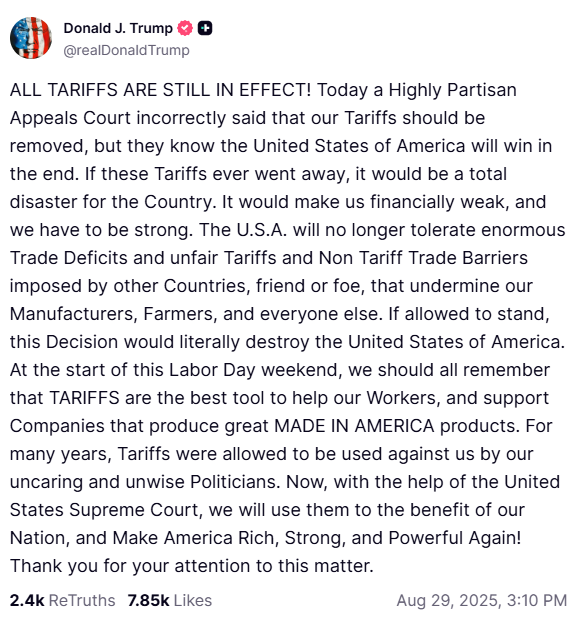
President Trump responded to the ruling with a fiery post on his Truth Social platform, vowing to fight on.
He blasted the court as “Highly Partisan” and warned that if the tariffs were ever removed, “it would be a total disaster for the Country.”
“Today a Highly Partisan Appeals Court incorrectly said that our Tariffs should be removed, but they know the United States of America will win in the end… TARIFFS are the best tool to help our Workers.” – President Donald Trump
The White House echoed this defiance, stating, “President Trump lawfully exercised the tariff powers granted to him by Congress to defend our national and economic security.”
A Supreme Court Showdown Looms
The appeals court has given the administration a window to appeal to the Supreme Court, and the tariffs will remain in place during that time. This sets the stage for a historic legal battle.
The high court will be asked to decide not just the fate of billions of dollars in tariffs that affect nearly every American consumer, but a fundamental constitutional question: In our modern, complex world, how much of Congress’s core economic power can a President wield on his own?
The answer will define the balance of power between Congress and the White House for generations to come.