
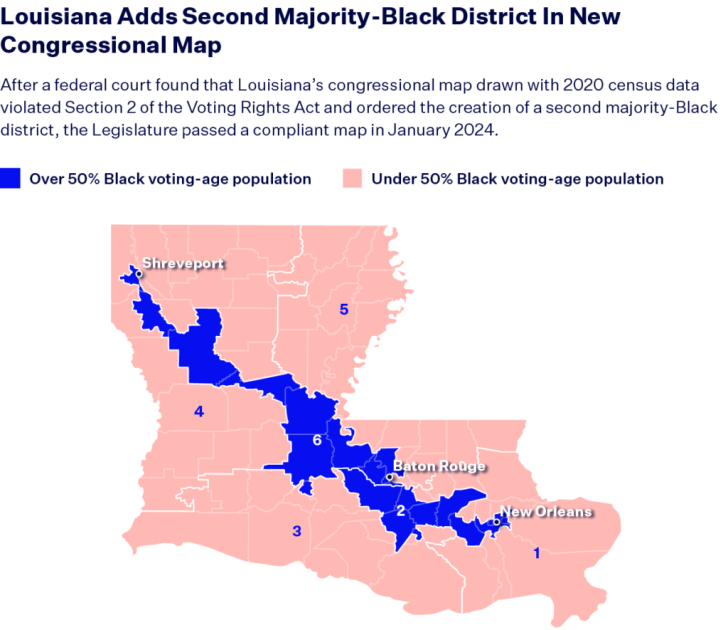
A panel of judges on the conservative Fifth Circuit Court of Appeals has struck down a Republican-drawn congressional map in Louisiana. The court ruled that the map is an unconstitutional racial gerrymander that violates the landmark Voting Rights Act of 1965.
This ruling is more than just a victory for civil rights advocates; it is a profound affirmation of one of our nation’s most important laws. In an era of intense political battles over redistricting, this decision breathes new life into the constitutional fight against racial vote dilution and serves as a vital lesson in how our system is designed to protect the principle of “one person, one vote.”
A Lesson in “Packing and Cracking”
At the heart of the court’s decision is Section 2 of the Voting Rights Act. This provision, a cornerstone of the law, prohibits any voting practice or procedure that results in the “denial or abridgement of the right of any citizen… to vote on account of race or color.”
The Fifth Circuit found that the Louisiana map violated this principle through two classic, unconstitutional techniques of vote dilution:
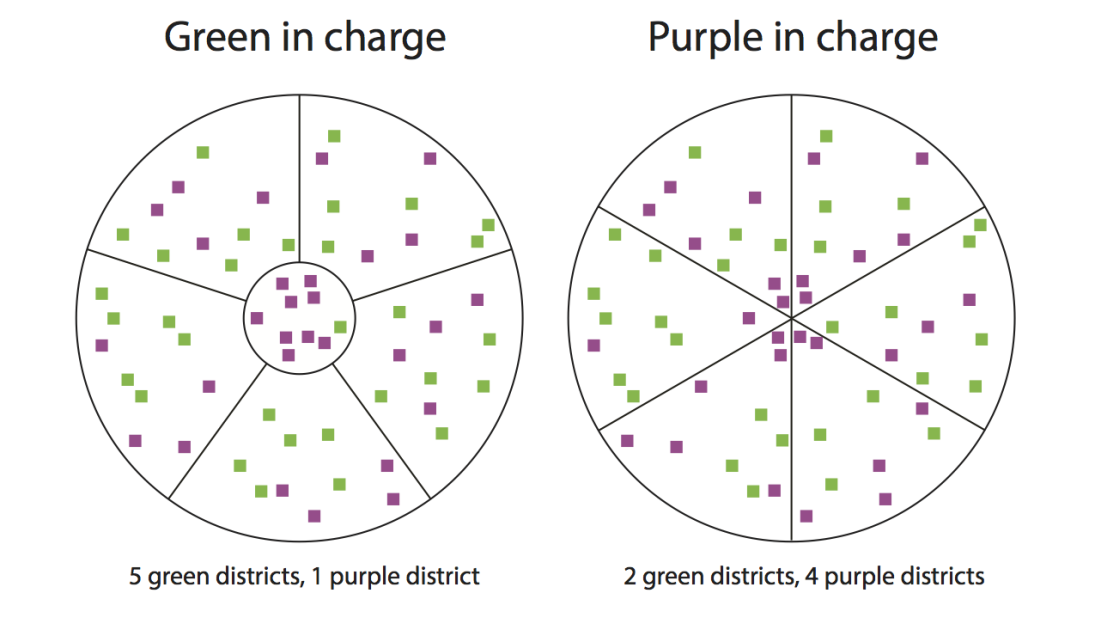
- “Packing”: The map’s designers had “packed” a large number of Black voters into a single congressional district in New Orleans, creating an overwhelming majority for them there. While this guaranteed the election of one Black-preferred candidate, it wasted thousands of their votes and diluted their influence in neighboring districts.
- “Cracking”: At the same time, other significant Black communities, like the one in the Shreveport area, were “cracked” – split apart and spread thinly across multiple districts. This ensured they would be a minority in each of those districts, depriving them of the opportunity to form an effective voting bloc and elect a candidate of their choice.
A Powerful Check on a Co-Equal Branch
The significance of this ruling cannot be overstated. In an era where the Supreme Court has weakened other sections of the Voting Rights Act, the Fifth Circuit’s decision demonstrates that Section 2 remains a potent and enforceable legal tool for combating racial discrimination in voting.
The fact that this ruling came from the Fifth Circuit – widely regarded as one of the most conservative federal appeals courts in the country – makes it even more powerful. It suggests that the evidence of vote dilution in the Louisiana map was so clear and overwhelming that it transcended the judges’ own political ideologies.
This is a testament to the power of the rule of law and the judiciary’s role as a necessary check on the political branches.
The Impossible Constitutional Puzzle
This ruling, however, also casts a harsh light on the chaotic and seemingly impossible constitutional puzzle of modern redistricting. While this court has struck down Louisiana’s map for diluting the Black vote in violation of the Voting Rights Act, the state’s revised map is simultaneously being challenged in a separate case that has reached the Supreme Court.
The argument in that second case? That in its effort to create a second majority-Black district to comply with the Voting Rights Act, the state relied too heavily on race, thus creating an unconstitutional racial gerrymander under the 14th Amendment.
This is the constitutional tightrope states are now forced to walk: they can be sued for considering race too little, and then immediately sued for considering it too much.
The Fifth Circuit’s decision is a crucial victory for the principle of fair representation. But it also serves as a stark reminder that the broader battles over the shape of our democracy are far from over. The Voting Rights Act was a landmark step in fulfilling the promise of the 15th Amendment, and this ruling shows that, sixty years later, it remains an essential – and fiercely contested – guardrail for our republic.