
A deadline has passed. A formal, legal demand from the United States Senate for documents related to the Jeffrey Epstein investigation has been met with silence from the Trump administration. Now, a constitutional showdown that has been simmering for weeks is set to boil over in federal court.
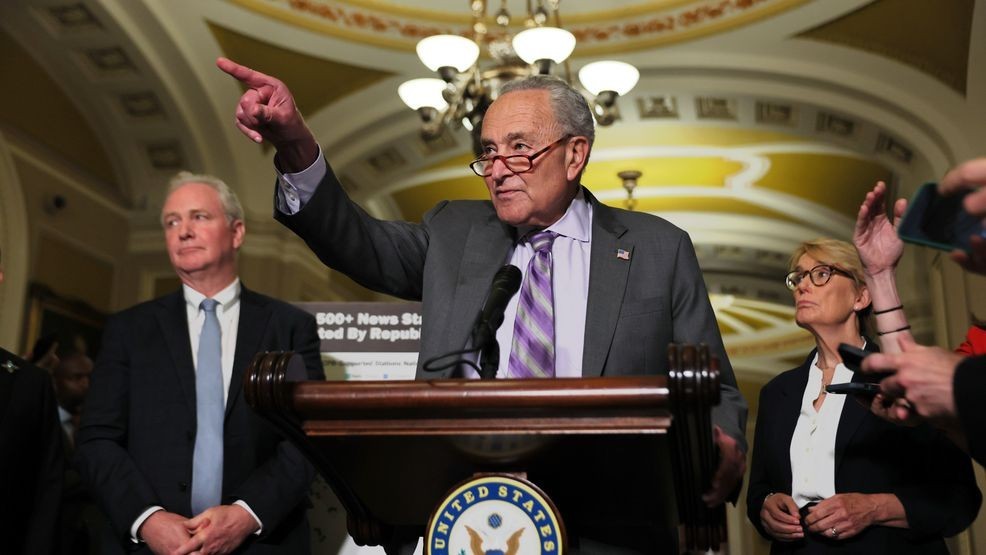
Senate Minority Leader Chuck Schumer, accusing the administration of “breaking the law to hide the files,” has threatened to sue if the documents are not produced. This moves the conflict from a political battle into a direct legal war over the separation of powers, one that will test the very limits of Congress’s power to conduct oversight and the President’s power to maintain secrecy.
The Law vs. The Executive
Last month, Senate Democrats invoked a powerful and rarely used tool of congressional oversight: a 1928 law known as the “rule of five” (officially 5 U.S.C. § 2954). The statute’s language is a clear command: an executive agency “shall” provide information and records when requested by five members of the Senate’s primary oversight committee.
The Democrats made their request, and the administration was given a deadline of Friday, August 15th, to comply. That deadline has now passed without the documents being turned over.
This act of defiance by the executive branch is what prompted Senator Schumer to declare that the administration is now “breaking the law.”
Can a Court Intervene?
The threat to “take them to court” brings this conflict to its logical and constitutionally fraught conclusion. This is not a simple case. It forces the judiciary to grapple with a profound question of “justiciability”—is this a dispute that the courts can, or should, resolve?

The argument from Congress is straightforward: a law was passed containing a clear, mandatory command (“shall”), and the executive branch has refused to comply. It is the judiciary’s fundamental duty, established in Marbury v. Madison, to interpret the law and compel a non-compliant executive to follow it.
The administration, however, will likely counter with a claim of executive privilege.
They will argue that the President has a constitutional right to protect the confidentiality of sensitive law enforcement files and internal deliberations. They will likely assert that this is a “political question,” a power struggle between the other two branches that the courts should stay out of.
The Unwritten Rules of Power
This standoff is a stark illustration of how our system of checks and balances has become strained in an era of intense polarization. The 1928 law was designed to be an irresistible force for transparency. It is now meeting the immovable object of a modern presidency determined to guard its prerogatives.
The situation also highlights Congress’s own internal divisions. The process for the Senate as an institution to sue the executive branch is complex and often requires bipartisan, supermajority support. Senator Schumer’s threat to “take them to court ourselves” is an acknowledgment that he may not have the Republican support to act on behalf of the entire Senate, forcing him to seek legal standing on behalf of just the Democratic members.
This lawsuit, if it proceeds, will be about far more than the sordid details of the Jeffrey Epstein case. It will be a historic test of the power of congressional oversight in an age of an increasingly powerful executive. The courts will be asked to answer a fundamental question: When the President defies a law passed by Congress, does Congress still have the power to make him listen? The answer will define the balance of power in Washington for years to come.