
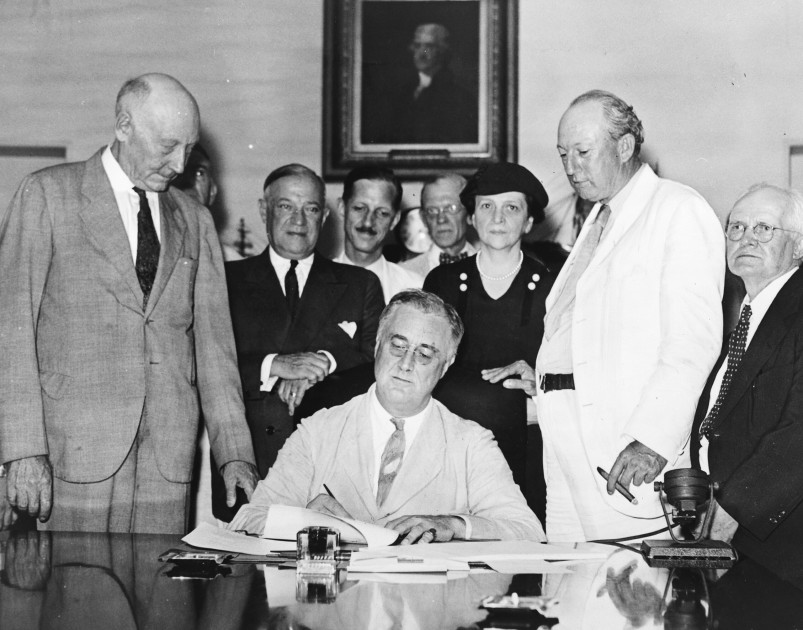
On the 90th anniversary of the Social Security Act, President Trump issued a proclamation celebrating the “monumental legislative achievement” and recommitted his administration to “always defending” the program. He boasted that under his leadership, the system is “stronger and more resilient than ever before.”
Yet, at the very same time, the President’s own chief actuary at the Social Security Administration has concluded that his signature legislative achievement – the “big, beautiful bill” signed into law last month – will actually speed up the program’s path to insolvency.
This jarring contradiction between the administration’s political rhetoric and its own expert analysis raises profound questions about fiscal responsibility and the constitutional duty to “provide for the general Welfare.”
A Tale of Two Messages
The White House is presenting a narrative of unqualified success. The presidential proclamation and statements from officials highlight a new, temporary $6,000 tax deduction for seniors, dramatically reduced customer service phone wait times, and a crackdown on fraud.
The President himself has dismissed long-standing concerns about the program’s future, claiming,
“In four or five years, it’s going to go bust, but not anymore, it’s not.”
The administration’s own experts, however, paint a starkly different picture. In a recent analysis, the Office of the Chief Actuary at the Social Security Administration projected that the new tax and spending law will have a negative impact on the program’s trust funds.
They forecast that the depletion date for the combined trust funds will now be accelerated by six months, moving from the third quarter of 2034 to the first.
The Constitutional Mandate of Promoting the “General Welfare”
This is a direct conflict that goes to the heart of a constitutional principle. Social Security, enacted by Franklin D. Roosevelt in 1935, is perhaps the single most significant exercise of Congress’s Article I power to spend for the “general Welfare.” It is a social contract between generations, a promise that those who work and pay into the system will have a basic floor of support in their old age.
A president’s constitutional duty is to “take Care that the Laws be faithfully executed.” This implies a good-faith effort to uphold and sustain the programs established by those laws. The critical question now is whether an administration can be said to be fulfilling that duty when it enacts policies that its own actuaries conclude will hasten the insolvency of our nation’s most important social safety net.
A Tax Cut in a Ticking Time Bomb
The administration has made the new tax break for seniors a centerpiece of its celebration. The President has called it the “largest tax break for seniors in the history of our country,” claiming it will allow the “vast majority” to pay “zero tax” on their benefits.
However, a closer look reveals that the impact is not universal. Because lower-income seniors often already pay little to no federal income tax on their Social Security benefits, a new tax deduction primarily benefits middle- and upper-income retirees who have higher overall incomes.
While providing tax relief is a legitimate policy goal, it is being done in the context of a program that is facing a long-term fiscal crisis that this very bill makes worse.
The 90th anniversary of Social Security should be a moment for sober, honest reflection on the challenges facing this vital program and the difficult choices required to preserve it for future generations. Instead, the administration is engaging in a dangerous contradiction, publicly celebrating the program’s health while championing legislation that its own experts say will weaken it.
The duty to protect the “general Welfare” requires not just celebratory proclamations, but fiscally responsible actions. The current disconnect between the President’s words and the mathematical reality of his policies is a profound disservice to the millions of Americans who depend on this program’s promise.