
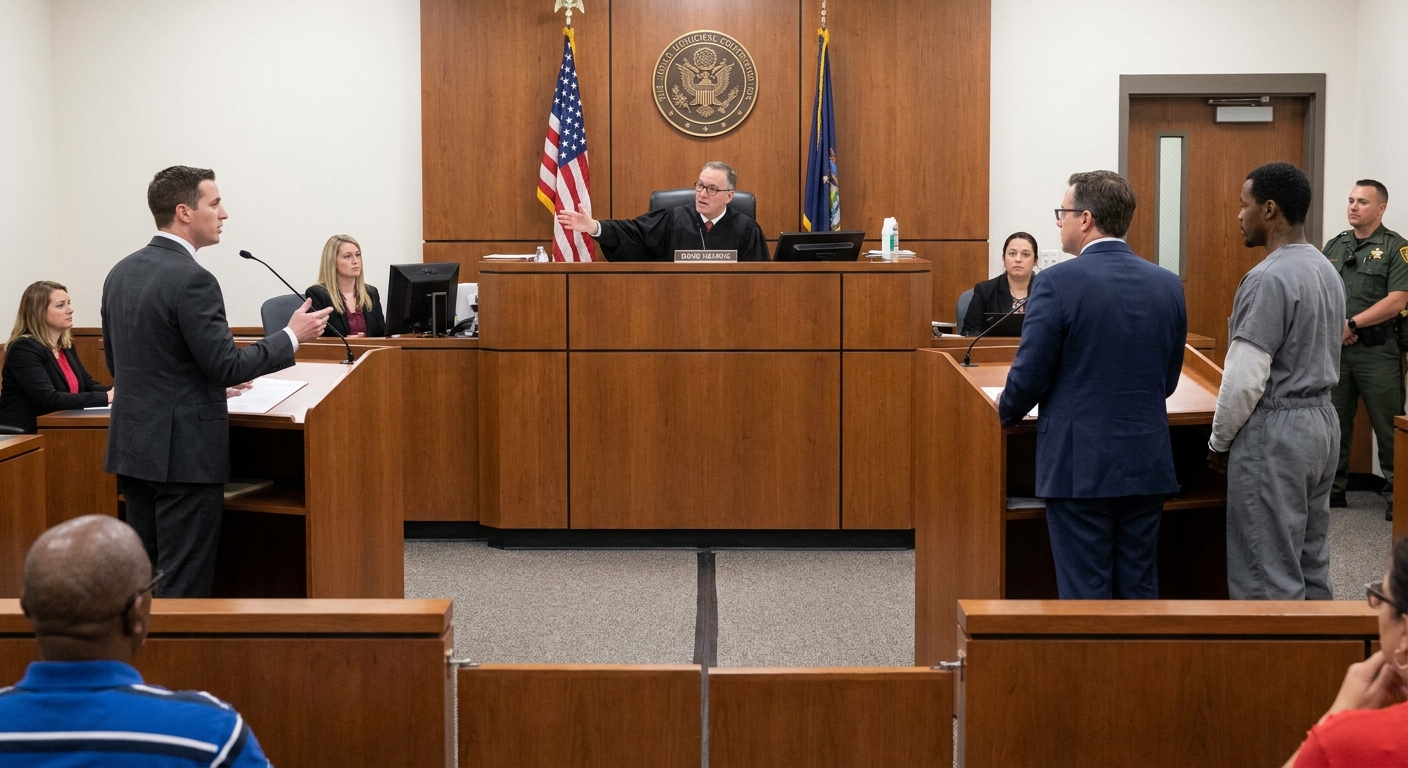
An arraignment sounds like a dramatic courtroom scene, but it is usually the opposite. It is brief, procedural, and often crowded. Yet it is one of the most constitutionally important checkpoints in the criminal process because it is a moment when the government must put the accusation on the record and the judge must ask, in substance, do you have a lawyer and do you understand what is happening.
If you want a one-sentence definition: an arraignment is a key early court hearing where the defendant is told the charge(s), advised of core rights, and asked to enter a plea, and where the court often addresses release conditions such as bail.
Note: This is general information, not legal advice. Procedures vary by jurisdiction, and small differences in timing and terminology can matter.

Join the Discussion
What happens at an arraignment
Exact details vary by state and by whether the case is in state or federal court, but most arraignments cover the same core items.
- The charge(s) are put on the record. The judge confirms what offense(s) the government has filed. In some courts the charges are read; in others they are summarized or referenced by the charging document.
- The defendant is informed of key rights. Courts nearly always address the right to counsel. Other advisements, like the right to remain silent, may be given orally, provided in writing, or handled differently depending on local practice.
- Lawyer status is confirmed. The judge asks whether you have an attorney. If you cannot afford one, the court begins the process of appointing counsel, usually a public defender.
- A plea is entered. Most defendants plead not guilty at arraignment. This preserves defenses and keeps the case on the normal track for discovery, motion practice, and negotiation.
- Bail or release conditions are addressed. The judge may set bail, release you on your own recognizance, impose conditions, or order detention depending on the jurisdiction and the facts. In some places, money bail starts with a schedule and is then reviewed by a judge.
- Future dates are scheduled. The court sets deadlines or dates for the next hearing, such as a preliminary hearing, conference, or trial setting.
What an arraignment usually is not: it is not a trial, witnesses typically do not testify, and the judge typically does not decide guilt or innocence.
Why arraignment matters constitutionally
The Constitution does not use the word “arraignment.” But arraignment sits at the intersection of several protections that do appear in the text and in long-running constitutional doctrine.
Notice of the accusation
The Sixth Amendment guarantees that an accused person must “be informed of the nature and cause of the accusation.” Many defendants receive paperwork earlier (a citation, complaint, or booking documents), but arraignment is a main way the system makes that guarantee real in open court: the case and charges are identified on the record and the defendant is put on formal notice.
The right to counsel
The Sixth Amendment also protects the right “to have the Assistance of Counsel.” In practice, arraignment is often the first courtroom moment where the judge ensures a defendant has a lawyer or begins the appointment process. That matters because critical decisions begin early, including release arguments and the preservation of defenses.
Due process, not surprise process
Under the Fifth and Fourteenth Amendments, criminal procedure is supposed to be lawful procedure, not ambush. Arraignment is part of the basic architecture of due process: the court identifies the case, records the plea, and starts a schedule that controls what comes next.
Bail and the Eighth Amendment
The Eighth Amendment prohibits “excessive bail.” That does not mean there is always a constitutional right to bail in every case, but it does mean bail cannot be set higher than is reasonably related to its lawful purposes, such as ensuring return to court and, where authorized by law, addressing public safety.
Arraignment vs. other early hearings
Because states use different labels, it helps to separate terms that people often mix together.
- Arraignment: The court formally identifies the charge(s), addresses counsel, takes a plea, and often handles bail or conditions.
- Bail hearing: Sometimes combined with arraignment, sometimes separate. The focus is release or detention and conditions.
- Preliminary hearing: In many felony cases, this comes later and asks whether there is enough evidence to proceed, often through testimony and cross-examination. Some jurisdictions use a grand jury instead.
- Initial appearance: In some places, the “initial appearance” is the first hearing after arrest, with arraignment occurring later when charges are filed in the trial court.
The plea and why “not guilty” is common
At arraignment, most defense attorneys enter a not guilty plea even when the situation feels obvious or the evidence seems strong. That is not gamesmanship. It is how you keep the case in the normal process where your lawyer can:
- get and review discovery (when it becomes available under local rules)
- investigate facts and defenses
- file motions (for example, to suppress evidence under the Fourth Amendment)
- negotiate with the prosecutor
- evaluate whether any plea deal is truly voluntary and informed
A guilty plea at arraignment is possible, but it is a serious legal decision because it can waive trial rights and lock in consequences quickly. Courts typically ask questions to ensure a guilty plea is knowing and voluntary.
Some jurisdictions also allow a no contest (nolo contendere) plea in certain cases. The availability and effect can vary, so it is something to discuss with counsel rather than assume is an option.
Bail and release conditions
At or near arraignment, the judge decides whether you wait for your case in jail or in the community under conditions. Different jurisdictions use different factors, but these are common:
- Risk of not appearing for future court dates
- Public safety concerns (where the law allows the court to consider them)
- The seriousness of the charge and alleged facts
- Criminal history and prior failures to appear
- Community ties like residence, employment, and family
“Bail” can mean money bail, but release conditions can also include supervised release, travel limits, no-contact orders, surrender of firearms, drug testing, or electronic monitoring.
One practical reality: even though the Eighth Amendment forbids excessive bail, challenges are fact specific and can be hard to win quickly. The more immediate lever is often a motion to reconsider bail supported by better information, stable housing plans, treatment plans, or sureties.
Your rights at arraignment
Arraignment is procedural, but it is not trivial. It is where core rights start to function on the record.
- Right to counsel. If you cannot afford a lawyer, ask the court about appointed counsel as early as possible.
- Right to remain silent. Statements you make can be used against you. In court, let your attorney speak for you when possible.
- Right to know the charges. You should leave knowing the exact charge name and level (misdemeanor vs felony) and any enhancements alleged. If you do not have a copy of the complaint, information, or indictment, ask how to get one.
- Right to reasonable conditions of release. If bail is set, your attorney can argue for lower bail or non-monetary conditions.
- Right to an interpreter. Courts generally provide interpreters when needed for meaningful participation, though procedures vary.
If something feels rushed, that is often because arraignment calendars move fast. But speed does not cancel rights. If you do not understand what is happening, say so, or have your lawyer say so.
Does arraignment mean you were indicted?
Not necessarily. There are multiple ways a criminal case can start:
- Complaint or information: Many state cases begin with a sworn complaint or an information filed by a prosecutor. Many misdemeanor cases also begin with a citation, meaning there may be an arraignment date even without a prior arrest.
- Indictment: Some felonies, especially in federal court, proceed by grand jury indictment.
You can be arraigned on an indictment, or arraigned on charges filed by other mechanisms. The arraignment is about formal notice and the court’s management of the case, not about which charging method was used.
Federal vs. state arraignments
In federal court, arraignment is governed primarily by the Federal Rules of Criminal Procedure (Rule 10), and it often follows an earlier “initial appearance” where a magistrate judge addresses counsel and detention. Detention and release are governed by the Bail Reform Act. In many state systems, those steps are blended or labeled differently.
The practical difference for most readers is not the label. It is the pace and the stakes. Federal detention decisions can be stringent in certain categories of cases, and federal scheduling orders can move quickly. State practice can range from very rapid to very backlogged depending on the county and docket.
What to bring and what to expect
- Expect it to be brief. Many arraignments take only a few minutes per case.
- Have basic information ready. Address, employment, family responsibilities, medical needs, and any prior court dates or probation status can matter for release decisions.
- Understand that the record matters. The plea and conditions set here shape the next steps.
- Ask for clarification. If you do not understand the charges or next date, you can ask.

Common questions
Can the charges change after arraignment?
Yes. Prosecutors can amend or add charges depending on the jurisdiction’s rules and the evidence. Defense lawyers can also seek dismissal or reduction through motions and negotiations.
Will I talk at my arraignment?
Usually very little. The court may ask you to confirm your name and whether you understand your rights. Your lawyer typically handles the plea and arguments.
Is an arraignment the same thing as a guilty plea hearing?
No. Some cases resolve with a guilty plea on the arraignment date, but a true plea hearing usually involves a detailed “colloquy” where the judge confirms you understand what rights you are giving up and the consequences.
What if I miss my arraignment?
Courts can issue a bench warrant and impose additional penalties. If a missed date was caused by an emergency or lack of notice, counsel can sometimes move quickly to address it, but the risk is real.
The civic point
Arraignment is not designed to persuade you of anything. It is designed to prove the government is following a process. That is the constitutional promise in miniature: the state cannot just accuse. It must accuse in court, on the record, with counsel available, and with a judge supervising the terms of your liberty while the case proceeds.
If you are reading this because you or someone you love has an arraignment coming up, consider this your north star: arraignment is the beginning of the formal case, not the end of the story.